Hindu Marriage Act 1955: Complete Legal Guide to Marriage & Divorce
Marriage in India is a sacred union, but it is also a
legal contract governed by the Hindu Marriage Act 1955. From visa applications to
property inheritance, failing to understand the legal requirements of your marriage can lead to serious
complications. This guide provides a comprehensive breakdown of the law as it stands in 2026.
To be legally recognized, a Hindu marriage must satisfy five essential conditions under Section 5:
1. Monogamy: Neither party must have a living spouse at the time of marriage.
2. Mental Capacity: Both parties must be of sound mind and provide free,
voluntary consent.
3. Legal Age: The groom must be 21 years old and the bride must be 18 years
old.
4. Prohibited Degrees: Marriage between close blood relatives is prohibited
unless allowed by custom.
5. Sapinda Relationships: Marriage is barred if there is a common ancestor
within 7 generations (paternal) or 5 generations (maternal).
Rituals and Legal Completion: Section
7
The Hindu Marriage Act Section 7 is unique because it treats religious ceremonies as the
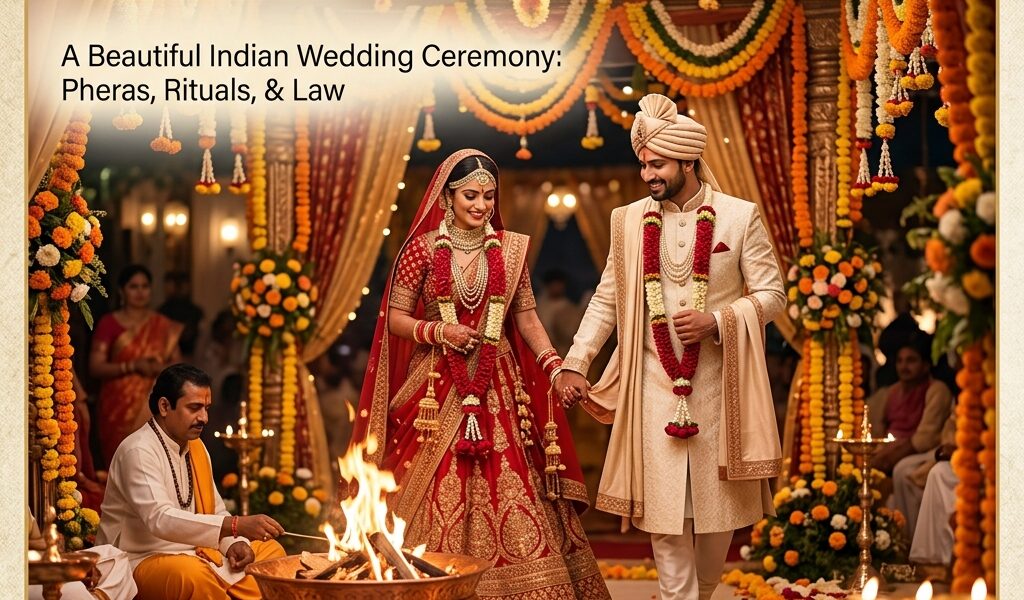
legal moment of union. The Saptapadi (seven steps around the holy fire) is the most
critical ritual. Under law, the marriage is considered "complete and binding" on the seventh step.
Actionable Tip: Ensure your ceremony is captured on video, especially the Saptapadi.
In legal disputes regarding property or maintenance, this video serves as powerful evidence of the
marriage's validity.
HMA 1955 vs. Special Marriage Act
1954
Aspect
Hindu Marriage Act 1955
Special Marriage Act 1954
Who it applies to
Hindus, Sikhs, Buddhists, Jains
Any two persons, regardless of religion
Ceremony
Religious rituals (e.g. Saptapadi) required
Civil ceremony before a Marriage Officer
Notice Period
Varies by state; minimal
Mandatory 30-day public notice
Interfaith
Both must be Hindu (or converted)
Permitted for any combination
Step-by-Step Marriage
Registration Process
Documentation: Age proof (Birth cert/Class 10), Address proof (Aadhaar/Passport),
and wedding photos/invite.
Sub-Registrar Visit: Visit the office in the area where the marriage was
solemnized.
Notice & Filing: Partners and two witnesses must be physically present for
verification.
Certificate Issuance: After signing the register, you receive the official
Government Marriage Certificate.
Note for Karnataka: Use the Kaveri Online Services portal to book appointments
and check status.
Grounds for Divorce and Annulment
The Act provides for both fault-based and mutual consent divorce:
Fault-Based (Section 13): Grounds include cruelty, adultery, desertion (2+ years),
and conversion.
Mutual Consent (Section 13B): Both parties must live apart for at least one year
and agree to the divorce.
Void vs. Voidable: A void marriage is invalid from the start (e.g.
bigamy). A voidable marriage can be annulled later (e.g. fraud or lack of consent).
Common Legal Mistakes to
Avoid
Mistake: Relying on a Temple Certificate
A pandit's receipt is NOT a legal document for passports, visas, or banks. Only a
certificate from the Sub-Registrar is valid.
Mistake: Ignoring Sapinda Rules
Overlooking blood-line restrictions can lead to your marriage being declared void.
Always verify lineage proximity legally.
How Riyo Advertising Simplifies
Matrimonial Ads
Whether you need to place a Matrimonial Ad in the Times of India, a Name Change
Notice after marriage, or a Court Notice for legal proceedings, Riyo
Advertising handles the entire process.
Matrimonial Classifieds: National and regional reach in Mumbai, Delhi, and
Bangalore.
Legal & Gazette Compliance: Expert management of mandatory newspaper publications.
One-Roof Solution: Designing, booking, and final placement management.
Frequently Asked Questions
Yes. The Supreme Court has made registration mandatory. A government marriage certificate is
required for passports, spouse visas, and insurance claims. A temple certificate is not
enough.
No. Under the HMA, both partners must be of the Hindu faith (including Buddhists, Jains, and
Sikhs). Interfaith marriages must be solemnized under the Special Marriage Act 1954.
Under Section 13B, there is typically a 6-month waiting period after filing. However, courts
can waive this if reconciliation is impossible and further waiting causes hardship.
Saptak Chattopadhyay is a brand enthusiast, a content strategist and a digital marketer working at Riyoadvertising.com. Saptak is a person with a talent of making interesting content that people can relate to and will assist businesses to build their brand and achieve quantifiable outcomes. He manages to combine creativity and data-driven knowledge to make his work conspicuous amidst the digital clutter. Saptak is enthusiastic about keeping abreast of industry trends and therefore constantly provides new and actionable strategies, which enable brands to grow and prosper. He can also be contacted saptak.riyo@gmail.com to collaborate and ask questions.