By Deborah Priyadharshini | Newspaper Advertising Consultant, Chennai | 14 years handling classified and display ad placements for Tamil Nadu and pan-India print campaigns
Matrimonial ads in Hindustan Times have survived smartphones, dating apps, and three generations of changing families. That alone tells you something.
I've placed hundreds of Hindustan Times Matrimonial ad listings over the years — for families in Delhi, for NRI candidates based in Toronto, and for parents who still believe the right words in the right newspaper matter. And honestly, they’re not wrong.
This guide is based on real experience, not theory.
The Legacy of HT Matrimonials: Why Parents Still Trust Print
There’s a kind of credibility that print still carries. It’s not easy to explain, but families who grew up reading Sunday editions of HT Classifieds understand it well.
For decades, HT has been a trusted place for matrimonial listings. Long before online portals existed, families relied on newspaper ads to find matches. It was slower, but it worked.
Even today, trust hasn’t fully shifted online. Many middle-class and upper-middle-class families in Delhi, NCR, and Lucknow still see a newspaper ad as a sign of seriousness. Saying “we’ve published in HT” still carries weight in family discussions.
One client from Karol Bagh insisted only on a Hindustan Times Matrimonial ad. Her logic was simple: anyone can create an online profile, but not everyone invests in a newspaper ad.
Print also reaches a different audience. Older family members — often the decision-makers — still read the matrimonial section daily. That matters more than people think.
Categorization: Search by Caste, Profession, or "Cosmopolitan"
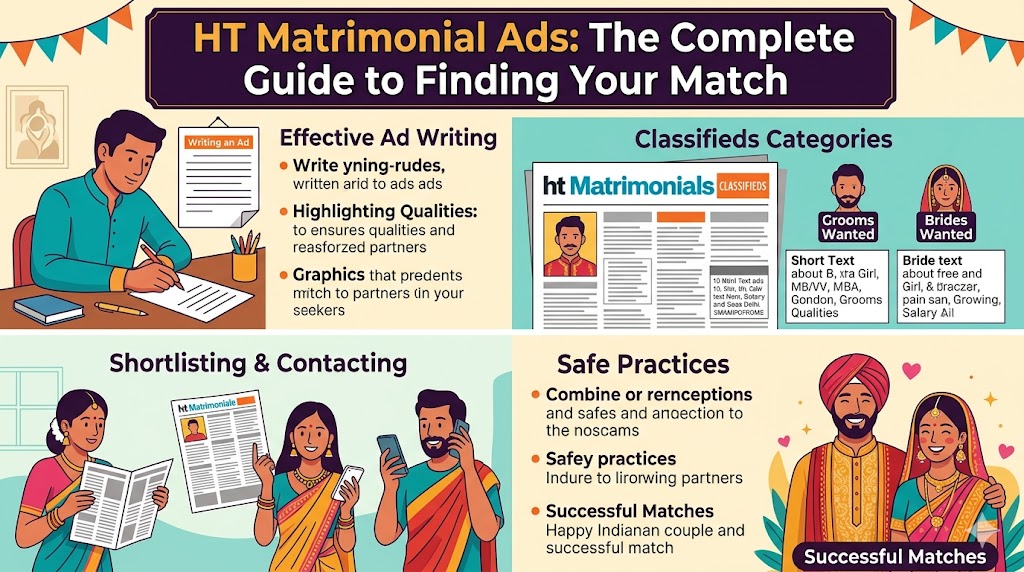
HT matrimonial listings are divided into categories that reflect how families actually search.
Main categories include:
Community/Caste-based — Brahmin, Kayastha, Baniya, Punjabi, Sindhi, etc.
Professional — Doctors, Engineers, Defence, IAS/IPS
Cosmopolitan — Open to all communities
NRI — For candidates abroad
Remarriage / Divorce / Widower — Separate, clearly defined sections
Choosing the right category is critical. Many families place ads without understanding the categories, which reduces response quality.
If you’re unsure between community-specific and cosmopolitan, be honest about your preferences. Clarity here avoids irrelevant responses later.
Writing an Effective Ad: Balancing Brevity with Detail
This is where most people struggle.
A good Hindustan Times Matrimonial ad should be short, clear, and informative.
Here’s how to do it right:
Start with key details. Example: “Hindu Brahmin, 29, software engineer, Pune-based, 5'10”” — this works better than vague openings.
Be clear about preferences. Mention caste, location, or openness to relocation.
Keep it concise. Ideally under 35 words for HT Classifieds text ads.
Add a clear contact method. Phone, email, or P.O. Box.
Proofread carefully. Errors in age, contact details, or city can ruin responses.
A well-written ad saves both time and effort.
Response Management: Handling Calls and Emails from the Ad
Once your ad is published, responses start quickly.
A Sunday Hindustan Times Matrimonial ad can generate anywhere from 15 to 50+ responses depending on the category.
If using a phone number:
Expect calls early in the morning. Make sure someone is available to answer and share basic details.
If using email:
Create a separate email ID just for the ad. Keep it simple and organized.
If you prefer privacy, you can use a P.O. Box. HT offers this option, where responses are collected through the newspaper office. It’s safer but slower.
Keep track of responses. A simple spreadsheet with names, contact details, and basic information helps avoid confusion.
Also, respond politely. Even a short acknowledgment message is appreciated.
Conclusion: Where Tradition Meets Modern Matchmaking
HT matrimonials serve a different purpose than apps. They offer credibility, family involvement, and a structured way of searching.
Today, many families also browse listings through the HT epaper classified today, which combines traditional trust with digital access.
The audience remains the same — only the medium has expanded.
So, does print still matter in 2026? For many families, the answer is yes.
It’s not about nostalgia. It’s about knowing what works for your audience.
FAQs: HT Matrimonial Ads Guide
Which day is best for booking a matrimonial ad in Hindustan Times?
Sunday. That’s the day most families read the matrimonial section with full attention. Booking a Hindustan Times Matrimonial ad on the best day almost always means Sunday — readership peaks then. Weekday insertions exist, but response volumes are lower. If your budget allows, choose Sunday.
How to book a matrimonial ad in HT Sunday edition?
You can book directly on the HT Media website or through authorized ad agencies. For the Sunday edition, submit your ad by Thursday. How to book a matrimonial ad in HT Sunday edition is simple — choose your category, write the text, select the date, and pay online. Agencies can help with faster processing and corrections, especially for first-time users of HT Classifieds.
What are the matrimonial ad rates for Hindustan Times Delhi?
Rates depend on the ad type — classified text, classified display, or display. Text ads are charged per word or line, while display ads are priced per column centimeter. Matrimonial ad rates for Delhi change frequently, so always check the latest rate card on the official portal before booking your Hindustan Times Matrimonial ad.
How to write a short and effective HT matrimonial ad?
Start with key details — community, age, profession, and location in one line. Then add your preferences like community, age range, or profession. End with contact details. Writing a good HT Classifieds matrimonial ad is about clarity, not creativity. Focus on relevant filters to attract the right responses.
Can I use a P.O. Box for responses to my HT matrimonial ad?
Yes. HT offers a P.O. Box service if you prefer privacy. Responses are sent to the newspaper office, and you can collect them. It’s slower than phone responses but more secure. This option is useful when placing a Hindustan Times Matrimonial ad and wanting controlled communication.
Is it better to book a matrimonial display ad or a text ad in HT?
It depends on your goal. Text ads are effective since readers usually go through their specific category in HT Classifieds. Display ads cost more and are useful if you want extra visibility or premium placement. For most users, text ads are sufficient.
How to browse HT matrimonial classifieds in the epaper?
Visit the HT epaper classified today section on epaper.hindustantimes.com. Go to the classifieds section and navigate to matrimonials. Listings are organized by sub-category, just like the print version. You can zoom, search, and browse easily from anywhere.
Does HT offer packages for multiple matrimonial ad insertions?
Yes, HT offers multi-insertion packages. These packages reduce the cost per insertion if you book multiple ads, especially for Sundays. If you plan repeated visibility in HT Classifieds, these packages are a cost-effective option.
What are the sub-categories available in HT matrimonial classifieds?
Sub-categories include community-based (Hindu, Muslim, Sikh, Christian, Jain, etc.), profession-based (Doctors, Engineers, Defence), Cosmopolitan, NRI, and Remarriage. Choosing the correct category in HT Classifieds is crucial for reaching the right audience.
How to book a matrimonial ad in HT for NRI candidates?
Select the NRI category while booking your Hindustan Times Matrimonial ad. The process is the same as regular booking — online or via an agency. Clearly mention the country of residence in the ad text, as families searching through the HT epaper classified today section often focus on this detail first.
Deborah Priyadharshini is a content writer at Riyo Advertising, where she creates clear, accurate, and reader-focused content across multiple industries. Her work covers newspaper advertising, legal notices, marketing communication, finance-related topics, and technology-focused subjects.
She specialises in writing content that is easy to understand, compliant with industry requirements, and suited for both businesses and the general public. With a strong eye for detail and clarity, Deborah focuses on helping brands communicate their message in a simple and trustworthy way.