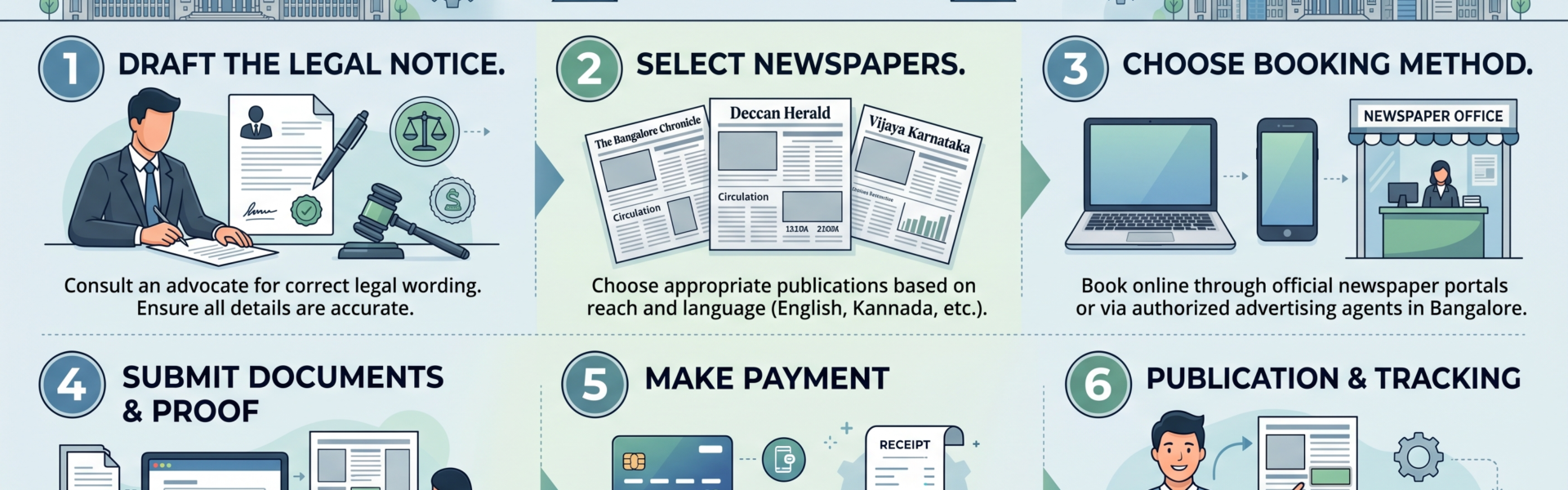
- Homepage
- book-legal-notice-bangalore-newspapers
- How to Book a Legal Notice in Bangalore Newspapers (2026 Guide)
How to Book a Legal Notice in Bangalore Newspapers (2026 Guide)
 admin
Posted on
admin
Posted on
Newspaper Advertising in Bangalore (2026): Why Tech Brands Still Choose Print
How Bangalore’s Leading Brands Use Print Media to Build Trust, Authority, and Measurable ROI
Here is a question worth sitting with: why does a city that built India’s digital economy still trust a piece of paper?
Google, Microsoft, Amazon and several hundred high growth startups have regional offices in Bangalore. It is said that it's hard to find a more tech-savvy workforce in the nation.
But, at the same time, when a luxury developer introduces a new project in Sarjapur, they put in a lot of money to advertise their project in the Times of India (Bangalore) in a jacket ad. A B2B tech company can't go wrong with a half-page ad in the Economic Times when it comes to the decision makers and CXOs of Bellandur.
This is not about "nostalgia" but a conscious decision on the part of the Bangalore print media. Knowing the reason makes for a master class in the role of brand authority in a market awash with digital noise.
The Paradox of India’s Silicon Valley: Overcoming Digital Fatigue
The tech corridor in Bangalore has created a unique problem for itself – digital ad fatigue. An average person from Koramangala or Whitefield receives thousands of sponsored posts, pre-roll ads and push notifications daily.
They have developed a mechanism to more or less completely filter this out of their brains.
The tech consumer behaviour in Bengaluru is at a surprising crossroads – the more digital centric the consumer is, the less he/she believes in digital only ads.
Retargeting through programs tends to be intrusive, and influencer ads are regarded as simply an exchange rate. In this atmosphere, sponsored content on social media is a cue to scroll more quickly, rather than more slowly.
The old vs. new argument is not valid when it comes to print and digital advertising in Bangalore. It's a discussion on authenticity and compelling brand positioning.
The permanence and legitimacy of a printed newspaper ad is something that no social media algorithm can match.
Why Print Outranks Digital for HNI Targeting in Bengaluru
The presence of a newspaper is a status symbol for brands that are geared towards the High-Net-Worth Individuals (HNIs) and the C-suite.
If you can use a digital banner and skip it, or block it, a newspaper ad in Bangalore is a must see when many executives are not looking at a backlit screen during the "slow morning" routine.
- Trust and Authority: In an era of deepfakes and misinformation, the credibility of print media remains a powerful differentiator.
- Localized Targeting: Newspapers provide the ability to target precisely, whether it's by reaching out to your local community with a Kannada-language paper like Prajavani, or to the academic community with The Hindu.
- The "Jacket Ad" Effect: In Bangalore’s highly competitive real estate market, the volume of a front page jacket ad is a sign of funds, confidence and stability of the project.
Advertising in newspapers is being promoted by the most successful brands in Bangalore as a part of a multi-channel marketing strategy, with the "old way" proving to be the best way to get through the clutter and confusion of 2026.
The Bangalore Print Playbook: How Tech Brands Build Trust and Track ROI in 2026
The "Verified" Advantage: Why Editorial Integrity Drives Print Advertising Trust in Bangalore
If your ad is appearing on the Deccan Herald's editorial page or a deep-dive analysis piece in The Hindu, a subconscious change happens: the credibility earned by the editorial or analysis article gets passed on to your brand.
This is known as the “halo effect” by marketing researchers and it is still a fundamental principle that underlies the trust of print ads in Bangalore.
The news maker industry has a long history of reputation building in Bangalore with credible media sources being known for credible and independent reporting.
They have the trust of their readers: the academic, legal and industrial elite of the city.
Your brand is passed on to these readers when they read your brand in those pages.
In contrast, digital platforms have a challenge with brand safety. A sponsored post on social media typically appears alongside unmoderated posts, misinformation or algorithms that create "rage-bait".
Print takes care of this risk. In addition, print media is permanent so that it is impossible to delete or edit the contents.
For industries such as:
Real Estate
Luxury Retail
B2B Technology
Financial Services
This stability is a sign of accountability and something digital ads can't replicate.
Reaching the "Information Elite": Targeting HNI and C-Suite in Bangalore
In order to reach out to the senior executives in Lavelle Road, Indiranagar or Sarjapur, it is essential to know what their morning routine is.
A large group of Bangalore's C-Class begins their day with a cuppa coffee and the actual newspaper.
Meanwhile, even though Bangalore is a digital native, a large segment of the C-Class kicks off the day with a cup of coffee and a real newspaper.
It's a choice for high attention advertisements environments, and it's not a habit.
The Quality of Attention
The medium of print is effective in targeting the HNIs because of its "lean-forward" effect in Bangalore.
Reading a newspaper is an active and attentive activity as opposed to passive 'infinite scroll' that is found in social media.
No pop up to interrupt the reader, no auto-play videos and nothing to distract the reader.
Those C-suite marketing strategies which rely on digital marketing alone, will miss this undivided attention.
When the decision-maker's mind is at its best, a full page ad in a top quality morning daily is in their mind.
Further, the “desk-life” of a newspaper spent in the office and in high-end waiting rooms for hours makes for numerous organic impressions unmatched by a skippable 5-second ad.
The "Phygital" Bridge: Measuring Print ROI in 2026
One of the most popular misconceptions surrounding marketing these days is that print cannot be tracked.
By 2026, newspaper QR code marketing has bridged the divide between physical and digital, making newspaper advertising an effective and powerful lead generation tool.
Now that the print-to-digital conversion strategies in Bangalore are in place, they're making sure that clear attribution paths are available using sophisticated tracking.
- Publication-Specific QR Codes: Using different codes for The Times of India vs. Hindustan Times, the Global Reader enables readers to quickly access the content they are interested in.
- WhatsApp Business API Integration: Luxury real estate brands in Bangalore use scan-to-chat integrations for high-intent buyers.
- Custom Vanity URLs: URLs for print ads can be customized to be memorable and easily tracked for direct traffic lifts in Google Analytics.
- AR Triggers: Tech savvy brands leverage AR to make a print ad more immersive through virtual experiences and product demos.
Measuring print ROI is no longer a guess, it's a matter of the right tracking infrastructure coming before the ink hits the paper.
Brand Perception: Are You "Real" or Just "Viral"?
It's very cheap to go viral in 2026, but it is difficult to build brand authority in Bangalore.
There is a clear pattern of tech consumer behaviour among the High-Net-Worth Individuals (HNIs) of Bengaluru—tech consumers are using digital media for entertainment, while traditional media for investments.
The Authority Signal of Print
Having a major daily mention of your brand is one of the quickest ways of indicating your brand has "arrived."
A B2B tech company getting a full-page in the Economic Times Bangalore edition gets noticed by the industry.
A prominent real estate developer having a presence in newspapers such as The Times of India or Deccan Herald conveys a sense of financial stability and commitment to the long term.
Complexity is another challenge that print institutional advertising handles better than short-form digital content.
Print offers a solid canvas for corporate stories, detailed explanations, diagrams, and value propositions without competing notifications.
The Hybrid Marketing Mix: Balancing Depth and Breadth in 2026
Media has become a blended strategy for the best marketing teams in Bangalore's technology corridor.
- Digital for Breadth: Scale, speed and top of funnel awareness through social media and programmatic ads.
- Print for Depth: Newspaper advertising in Bangalore builds trust, attention, and high-intent engagement with decision-makers.
The 2026 Conversion Formula
There is no need to choose between digital or print ROI—you can have both.
Print campaigns for marketing in Bangalore today are used to give the final "signal of legitimacy" while digital marketing creates a "shadow of awareness".
In industries such as luxury real estate and high-end healthcare, this hybrid strategy consistently outperforms single-channel campaigns.
You're not just showing your prospect a hit in their social stream, you're showing them a hit in their trusted morning newspaper.
Frequently Asked Questions About Print Advertising in Bangalore’s Tech Market
-
1. Does print advertising still reach the younger tech workforce in Bangalore?
While Gen Z dominates digital consumption, senior executives and decision-makers aged 35–55 still maintain strong newspaper reading habits. -
2. Why is Deccan Herald considered trustworthy for Bangalore-centric brands?
Decades of credible journalism in Karnataka have given Deccan Herald a strong editorial halo effect. -
3. How can I track whether my
newspaper ad in Bangalore
is actually working?
QR codes, WhatsApp APIs, and vanity URLs allow brands to measure print-to-digital conversions in real time. -
4. Is print advertising more expensive than digital?
Print may cost more upfront but often produces higher-intent leads and stronger customer lifetime value. -
5. How do I make my print ad interactive?
Use QR codes, AR features, scan-to-chat systems, and appointment booking links. -
6. Does newspaper advertising help SEO?
Yes. Print campaigns increase branded search volume and improve brand authority signals. -
7. Which newspapers are best for B2B technology advertising?
Economic Times Bangalore and The Hindu are among the strongest choices. -
8. Can I target areas such as Indiranagar or Whitefield?
Yes. City supplements and metro editions help target Bangalore micro-markets effectively. -
9. What is ad blindness?
Ad blindness is when users subconsciously ignore digital advertisements due to repetitive exposure. -
10. How long does a newspaper advertisement stay active?
Newspapers remain visible on desks, breakfast tables, offices, and lounges throughout the day.
Conclusion: The Bangalore Hybrid Funnel
The smartest brands in Bangalore have abandoned the question "print or digital".
Instead, they ask: "Where does each channel fit into our funnel and why?"
In 2026's marketing world, digital remains dominant at the top of the funnel — building awareness, collecting data, and maintaining visibility.
Print advertising in Bangalore pays off at the bottom of the funnel — building legitimacy, trust, and focused engagement with serious buyers.
Print advertising trust is no longer a measure of the past — it is a competitive advantage in today's screen-saturated marketing environment.
In Bangalore’s technology corridor, the most successful brands use digital media to trend and print media to close.
