SEO vs Google Ads ROI for Bangalore Tech Firms 2026
 Sahil Singh
Posted on
Sahil Singh
Posted on
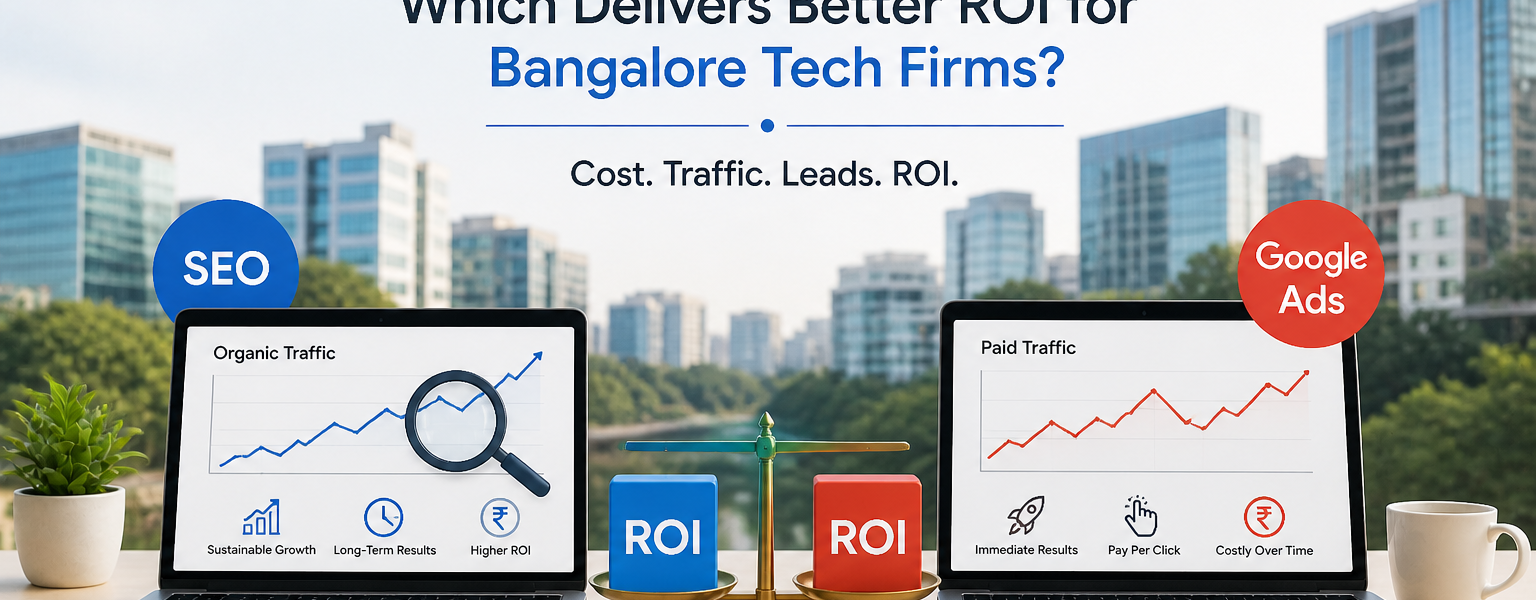
SEO vs Google Ads ROI for Bangalore Tech Firms in 2026
Table of Contents
- Introduction: The SEO vs Google Ads Decision
- Why This Decision Matters More for Bangalore Tech Companies in 2026
- Understanding the Core Difference: Speed vs. Compounding Returns
- How to Compare SEO vs Google Ads: A Side-by-Side Breakdown
- The Hybrid Strategy: What the Numbers Actually Suggest
- Common Mistakes Bangalore Tech Firms Make When Choosing
- Mistake 1: Running Google Ads Without a Conversion-Optimised Landing Page
- Mistake 2: Abandoning SEO After 90 Days
- Mistake 3: Ignoring Local SEO for B2B Services
- Mistake 4: Not Using Negative Keywords in Google Ads
- Mistake 5: Treating SEO and Google Ads as Separate Silos
- Best Tools for Managing SEO and Google Ads ROI in Bangalore
- How Riyo Advertising Helps Bangalore Businesses
- Talk to the Riyo Advertising Team
- Frequently Asked Questions About SEO vs Google Ads ROI
Introduction: The SEO vs Google Ads Decision
Let's say you've just raised a seed round and you've got a budget of ₹2 lakh to spend on marketing. Your CTO says, "Do some Google Ads." Your content lead says, "We need SEO." Your CFO says, "What are the numbers?" Sound familiar? For most IT founders in the Outer Ring Road district of Bangalore, the decision between SEO and Google Ads to drive return on investment (ROI) is one of the most important — and most misunderstood — budgetary decisions.
Both can deliver leads of value. Both have their costs. But they work on radically different time frames, and getting the mix wrong at the wrong time can bleed a marketing budget dry without producing many results. In this article, we'll outline the real costs and benefits of organic search and paid ads for the tech industry in Bangalore.
Why This Decision Matters More for Bangalore Tech Companies in 2026
It's become more expensive to play the tech game online in Bangalore. According to industry data tracked by Google and third-party sources, the typical cost-per-click (CPC) in Bangalore for keywords related to SaaS, cloud services and IT services has risen consistently as more companies have moved advertising spend online since 2022. Keywords like "cloud security solutions" or "enterprise SaaS platform India" now attract CPCs of ₹80 to ₹280 depending on campaign quality.
Conversely, organic search has become harder to win — but more rewarding. The 2024–2025 Google algorithm updates mean a light-touch SEO approach yields next to nothing, while a robust approach can create a genuine competitive moat.
The takeaway for 2026: nothing is free anymore. It's no longer about which channel to choose, but which matters most right now — for your growth goals and your timeline.
Actionable takeaway: Before setting a marketing budget, map your growth timeline. If you need leads in 30 days, you need to advertise. If you need sustainable growth 12 months from now, start investing in SEO in the first half of the year.
Understanding the Core Difference: Speed vs. Compounding Returns
The simplest way to think about organic vs paid: Google Ads is leasing traffic; SEO is acquiring an asset. One delivers immediately — the other builds compounding value over time.
How Google Ads Works for Tech Firms
Google Ads gets your listing to the top of the search results quickly — but only as long as you keep paying. The moment you stop, your ad disappears. This immediacy is genuinely valuable for a Koramangala-based B2B SaaS company that needs qualified demo requests within two weeks of a product launch.
The challenge is economics. With an average deal size of ₹50,000, a CPC of ₹150, a 2% click-to-lead conversion rate and a 15% close rate, you're paying approximately ₹5,000 per customer — just from paid search costs, before agency or management fees.
How SEO Works for Tech Firms
SEO earns Google's trust over time — through technical excellence, content, and backlinks. A properly optimised page can hold a top-3 ranking for years with near-zero marginal cost per click. Organic results are also more trusted by B2B buyers: a tech decision-maker at Wipro, Mphasis, or a Series A startup in HSR Layout is more likely to click an organic result than a sponsored listing when researching enterprise software.
The caveat: SEO results realistically take 4–9 months to appear for competitive keywords. Longer-tail terms like "legacy migration services for Bangalore fintech companies" can rank faster — 6–8 weeks with the right content structure.
Actionable takeaway: If your average customer lifetime value exceeds ₹1 lakh, the ROI on SEO is almost always positive over an 18-month horizon. Do the maths before committing to a paid-only strategy.
How to Compare SEO vs Google Ads: A Side-by-Side Breakdown
The table below compares both channels across the factors that matter most to Bangalore tech companies making budget decisions in 2026.
| Factor | SEO | Google Ads |
|---|---|---|
| Time to first result | 4–9 months for competitive terms; faster for niche keywords | 24–48 hours after campaign launch |
| Cost structure | Upfront investment in content & technical work; near-zero cost per click once ranking | Pay per click — ongoing; stops the moment budget pauses |
| Long-term ROI | Compounds over time; can exceed 500% ROI after 12–18 months | Predictable but flat — ROI tied directly to ongoing spend |
| B2B buyer trust | Higher — decision-makers trust organic results more than sponsored listings | Lower — 'Ad' label creates scepticism among savvy buyers |
| Keyword testing | Slow — takes months to verify which content converts | Fast — run a 2-week campaign to see what converts before writing content |
| Competitive keywords | Difficult if starting from zero domain authority | Accessible immediately if budget allows higher bids |
| Best use case | Established firms, content-driven SaaS, long-term brand building | New launches, event-driven campaigns, retargeting, brand defence |
The Hybrid Strategy: What the Numbers Actually Suggest
Most successful Bangalore tech companies don't choose between channels — they sequence them based on growth stage.
Early-stage startups (0–18 months):
Allocate approximately 65–70% of digital budget to Google Ads for immediate lead generation and market validation. Simultaneously invest 30–35% in foundational SEO: technical audit, core landing page optimisation, and a small volume of high-intent content targeting niche, low-competition keywords. Use Google Ads conversion data to identify which keywords are driving actual signups or demo requests — then build SEO content around exactly those terms.
Growth-stage firms (18 months+):
Shift toward an SEO-majority mix (55–65%) as organic rankings develop and cost-per-acquisition begins to fall. Maintain Google Ads for retargeting, brand protection (bidding on your own company name to prevent competitor ads appearing above your organic listing), and seasonal campaign bursts. Use Google Search Console to monitor which organic queries are driving traffic — then double down on that content category.
Actionable takeaway: Run a 2-week Google Ads sprint on 5–10 keywords before committing to any long-form SEO content. The conversion data you collect is worth more than any keyword research tool alone.
Common Mistakes Bangalore Tech Firms Make When Choosing Between SEO and Google Ads
Mistake 1: Running Google Ads Without a Conversion-Optimised Landing Page
One of the costliest mistakes in digital marketing ROI is driving paid traffic to a homepage or generic services page. A landing page that takes more than 3 seconds to load, or buries its CTA, means you're paying ₹100–₹250 per click to bounce visitors away.
Fix: Use a single-purpose landing page for each campaign. Validate it with Google's PageSpeed Insights before spending a rupee on advertising.
Mistake 2: Abandoning SEO After 90 Days
Founders who see no traffic movement in the first quarter often conclude SEO doesn't work in their niche. The reality is that most competitive tech keywords don't move until month 5–7, with significant traffic gains typically emerging between months 9–12. Stopping at month 3 is the equivalent of withdrawing from a compound interest account before it matures.
Fix: Set realistic 6-month milestones — technical health, keyword ranking movement, domain authority growth — rather than month-1 traffic targets.
Mistake 3: Ignoring Local SEO for B2B Services
An IT consulting firm in Whitefield may not see local SEO as relevant for B2B. In reality, many enterprise procurement managers in Bangalore actively search for "[service type] firms near Bengaluru" or "[service] companies in Bangalore" when shortlisting vendors — particularly for mid-market projects.
Fix: Claim and optimise your Google Business Profile, list your firm in relevant Indian B2B directories, and create location-specific pages on your website.
Mistake 4: Not Using Negative Keywords in Google Ads
Without a robust negative keyword list, your Bangalore SaaS ads will appear for irrelevant searches — burning budget on low-quality clicks. If you're targeting enterprise buyers, exclude "free", "tutorial", "salary", and "internship" from day one.
Fix: Spend 30 minutes building a negative keyword list before launching any campaign. Review the Google Ads Search Terms report weekly for the first month.
Mistake 5: Treating SEO and Google Ads as Separate Silos
Without data sharing between paid and organic teams, you'll end up bidding on keywords you could rank for organically, and writing content for keywords that don't convert in ads.
Fix: Run a monthly cross-channel review. Export your ad keywords and check their organic ranking in Google Search Console. If a keyword is already ranking in positions 1–3, consider reducing ad spend on that term and reallocating budget elsewhere.
Best Tools for Managing SEO and Google Ads ROI in Bangalore
Google Search Console — Free. Tells you exactly which organic queries are driving clicks and impressions. Essential for tracking SEO progress and identifying quick-win pages to optimise. Check it weekly.
Google Ads Keyword Planner — Free with a Google Ads account. Use it to validate search volume and estimated CPC before investing in content or campaigns for specific terms.
PageSpeed Insights — Free. Enter any landing page URL and get a Core Web Vitals score. Anything below 70 on mobile is costing you conversions from paid traffic.
Semrush or Ahrefs — Paid, starting ~₹8,000/month. Use for keyword difficulty analysis, competitor gap research, and backlink monitoring. Worth the investment once you're running campaigns above ₹50,000/month.
Google Analytics 4 — Free. Set up Source/Medium tracking to see exactly how many leads came from 'google / organic' vs 'google / cpc' — this is the only reliable way to compare ROI between channels.
24-hour quick win: Log into Google Search Console today. Click on Performance → Search Results. Sort by Clicks. Look for any page with 200+ impressions and fewer than 10 clicks — this page can rank significantly better. This week, add 2–3 of its target keywords into the page's title tag and meta description.
How Riyo Advertising Helps Bangalore Businesses with SEO and Google Ads Strategy
Bangalore tech founders know the theory of how to combine SEO and paid search — the catch is the practice. Identifying the right keyword infrastructure, setting up conversion tracking correctly, publishing content consistently, and optimising campaigns week after week requires a team that lives and breathes these channels. For most startups and SMEs, that team doesn't exist in-house — and it shouldn't have to.
This is where Riyo Advertising comes in. As a full-service digital marketing agency in Bangalore and Mumbai, Riyo brings the entire strategy and execution process in-house — no juggling between a separate SEO agency, a paid search vendor, and a content company that aren't communicating.
The Riyo Diagnostic: A 360-Degree Growth Plan
The process begins with a deep-dive diagnostic to identify exactly where your budget is leaking and where your biggest opportunities lie:
- Google Ads Audit: A structural review of your existing account (or a ground-up build) focusing on Search, Display, and Performance Max campaigns.
- Technical SEO Audit: Fixing Core Web Vitals, crawlability, and indexing issues that are suppressing your organic rankings.
- Keyword Gap Analysis: Identifying high-intent terms your Bangalore competitors are ranking for that you aren't.
- Execution Roadmap: A concrete 3-month plan with milestones tailored to your specific growth stage — not vague promises of "lifting rankings."
Integrated Services for Bangalore's Tech Ecosystem
Riyo Advertising specialises in performance marketing for Bangalore startups and established SMEs:
- Google Ads Campaign Management: Expert PPC handling to lower your cost-per-lead.
- SEO Audits & Continuous Optimisation: Driving long-term organic growth through technical excellence and authority building.
- Landing Page Reviews & CRO: Ensuring the traffic you drive actually converts into revenue.
- Content Strategy: Data-driven content that satisfies both Google's algorithms and human readers.
- Integrated Media Planning: For brands combining digital ads with offline channels like newspaper advertising or OOH.
Riyo has partnered with tech brands across Indiranagar, Koramangala, and Whitefield — delivering measurable CPL improvements in paid campaigns within 60–90 days and sustainable organic traffic growth within 5–7 months of consistent SEO effort.
Talk to the Riyo Advertising Team — We'll Help You Get Started
Reading a comparison article is useful. Applying it to a specific business — with its own market conditions, break-even point and sales funnel — is something else entirely. Riyo Advertising is here to bridge that gap.
When you call or speak with our team (Jyostna or Dinesh), we'll assess your current situation: what's working, what's wasted, and where you can make the biggest impact. There's no pressure and no obligation from the initial conversation — just an honest assessment from people who spend their days working with these channels on behalf of Indian companies.
📞 Call: +91 9137174164
🌐 Website: https://riyoadvertising.com/
👤 Ask for: Jyostna or Dinesh
Whether you're a first-time caller or a returning client, you'll speak with someone who knows the subject — not a script-reader.
Frequently Asked Questions About SEO vs Google Ads ROI
Is Google Ads better than SEO for a new SaaS startup in Bangalore?
Yes, for the first 6–12 months — Google Ads is the right tool for generating the traffic volume needed to quickly test product-market fit and gather conversion data. But without an SEO foundation, your customer acquisition cost will never decrease. The best Bengaluru SaaS companies use paid ads to build pipeline while using SEO to reduce the long-term cost of that pipeline.
How much should a Bangalore tech company budget for Google Ads monthly?
At least ₹30,000–₹50,000 per month is required to collect meaningful data in tech verticals. Below this threshold, campaigns are typically outbid on high-intent keywords before enough clicks accumulate for data-driven decisions. Smaller budgets are better applied to less competitive, long-tail keywords.
Does running Google Ads improve my organic SEO ranking?
No — Google explicitly states there is no direct link between running ads and organic ranking. Indirect benefits can occur through increased brand search volume and awareness, which are positive signals. But Google's algorithm doesn't share data between channels — even if buyers do.
Why are CPCs so high for tech keywords in Bangalore?
Bangalore is India's tech capital, with a high concentration of well-funded companies bidding on the same terms. Keywords like "cloud security system," "corporate HR software," or "AI analytics platform" attract bids from multinational and well-capitalised Indian companies. The fix isn't to avoid these keywords — it's to improve your Quality Scores by building more relevant landing pages, which lowers your effective CPC relative to competitors.
How do I measure which channel is delivering better ROI?
Configure Google Analytics 4 to track Source/Medium and set up separate goal conversions for lead forms, demo requests, and trial signups. Compare the cost-per-conversion of 'google / organic' vs 'google / cpc' over the past 90 days. For B2B with longer sales cycles, also track which source generates leads that eventually close — using CRM integration with UTM parameters.
Can a Bangalore IT services firm rank on Google without paid ads?
Yes — and many do. IT services firms with strong domain authority, well-structured service pages, and consistent content publishing can rank for high-value terms without any paid spend. The timeline is typically 9–18 months for Tier 1 keywords. The strategy works particularly well for niche positioning (e.g., "DevOps consulting for Bangalore fintech") where competition is lower and buyer intent is highly specific.
This guide is regularly updated to reflect the latest digital marketing trends and cost benchmarks for Bangalore tech companies. Last updated: May 2026.