SEO Meets PR: How to Rank on Google's Page 1 for "Best [Your Service] in Mumbai"
Table of Contents
- I. Introduction: Welcome to "The Page 5 Grave"
- II. Why Google Trusts News Sites More Than Your Own Website
- III. The Art of SEO-Friendly Press Release Writing
- IV. Online Reputation Management (ORM) Mumbai: Controlling the First Impression
- V. Riyo Advertising's Double-Edged PR Strategy
- VI. Tangible ROI: What Actually Happens When You Rank
- VII. Conclusion: PR Gets You Famous. SEO Gets You Found. Together, You Dominate.
- FAQ Section
I. Introduction: Welcome to "The Page 5 Grave"
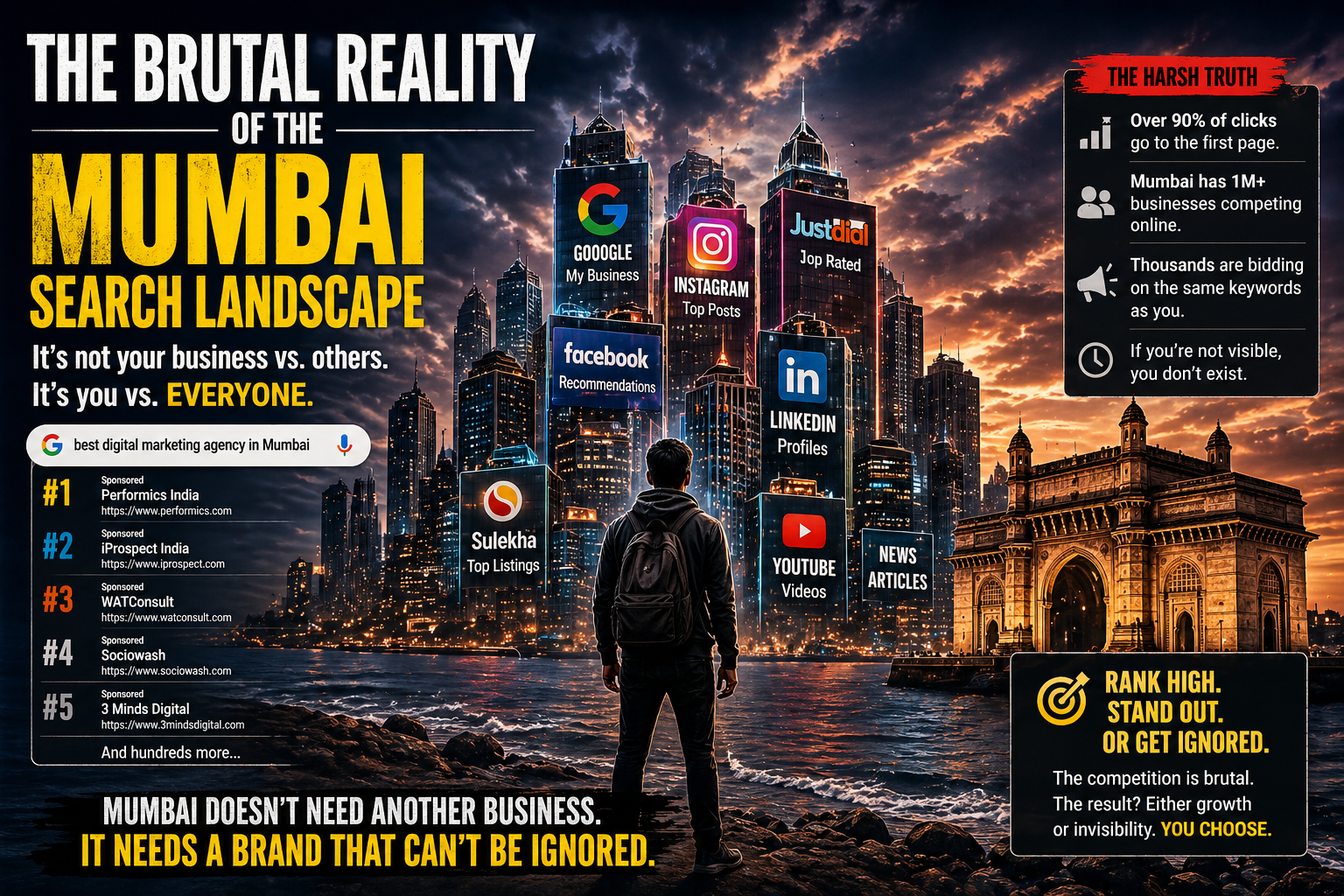
The Brutal Reality of the Mumbai Search Landscape
In Mumbai, there's a brutal joke among digital marketers: "If you want to bury a body, bury it on Page 2 of Google."
It sounds harsh, but it's the truth. If your business is sitting on Page 2, 3, or—God forbid—Page 5, you might as well be invisible. Research consistently shows that more than 91% of users never click past the first page. Even more staggering? The top 3 results for high-intent searches like "best [service] in Mumbai" account for more than 55% of all clicks.
Whether you are a stellar cosmetic dentist in Bandra, a world-class IVF centre in Andheri, a high-end law firm in BKC, or a luxury interior designer in Worli—if you aren't on Page 1 for your primary service keyword, you aren't just losing rank; you are losing the Mumbai local market to competitors who understand the new rules of the game.
The SEO Lie: Why "Keyword Stuffing" is a Dead End
The typical pitch for Mumbai businesses from a generic PR agency in Mumbai or SEO firm is: "We'll keyword your site, write a few blogs, tweak your meta-tags, and you'll rank."
That is the "SEO Lie." The reality is that Mumbai is no longer an on-page SEO-friendly city—it's a battleground of authority. Your competitors have already done the basics. Every doctor, lawyer, and D2C brand has already optimized their title tags. In 2024, Google values something much harder to fake than a few meta-tags: Authoritativeness.
Google's algorithms (specifically E-E-A-T) no longer prioritize what you say about yourself on your own website. Instead, they value what the rest of the internet—specifically high-authority news sites—says about you. This is where traditional SEO ends and Digital PR Mumbai begins.
The Authority Shortcut: Press Release Distribution Mumbai
To dominate the search results for "best [service] in Mumbai," you need more than a blog; you need media coverage Mumbai.
When you utilize professional press release distribution services Mumbai, you aren't just getting a news story—you are generating a "power signal" to Google. A single mention or feature in a trusted publication like Mid-Day, The Economic Times, or a localized press release Mumbai in Maharashtra Times is worth more than 500 low-quality blog comments.
This is the intersection of SEO and PR strategy. By leveraging press release distribution services Mumbai, you can build the kind of digital authority that no amount of on-page SEO can replicate.
The Dynamic Duo: Digital PR to the Rescue
Digital PR is the marriage of two disciplines that used to be housed in different silos:
- Public Relations → which earns you journalistic credibility
- Search Engine Optimization (SEO) → which earns you Google points
What happens when you put these two together? When you get a story in The Times of India, Mid-Day, Economic Times, or Hindustan Times, you not only get a reader - you get a signal from Google's algorithm that you are a real, cited, credible authority in your industry. That's gold in the eyes of Google.
Thesis
Writing press releases that are SEO-friendly is the most underutilised, high-impact strategy Mumbai has. If you do it properly, it gets you to Google's Page 1 - and keeps you there - without the ongoing cost of advertising. Here's how to do it.
II. Why Google Trusts News Sites More Than Your Own Website
If you want to master SEO, you need to know what Google is up to. Google's goal is to present the most credible result for whatever you search for. But how does the algorithm determine what's trustworthy?
By using a measure called Domain Authority.
The Basics of Domain Authority (DA)
All websites on the internet are rated on a scale of 0 to 100 - known as Domain Authority (or DA) - according to how many and how good other websites link to it. Here's the approximate breakdown:
- Your new website for business: DA 5-20
- A small-to-medium-sized Mumbai business that's 5+ years old: DA 20-35
- An industry-specific blog: DA 30-50
- Live Law, Bar and Bench, Moneycontrol: DA 70-85
- Mid-Day, Hindustan Times: DA 85-90
- The Times of India, Economic Times: DA 90-94
When your site (DA 15) receives a link from a site with DA 90, Google basically says: "Well, if The Times of India is linking to this brand, they must be OK." This can far outweigh hundreds of links from untrusted blogs.
The "Google News Tab" Advantage
Most business owners fail to consider this. If a customer is looking for "Best IVF clinic in Mumbai", Google will display a News carousel above the main search results. If your press release has been picked up by a news website, your news story can get listed in this carousel - effectively putting you above the page 1 listings.
This is the most valuable virtual real estate. And it's nearly impossible to buy. You have to earn it - and the way you do that is with SEO-friendly press release writing.
Earned Keyword Integration
The last element is the power of anchor text optimization. If the news article links to your site with the clickable text "best dermatologist clinic in Bandra" then Google will interpret this as, "This website is about 'best dermatology clinic in Bandra' - rank it for that search."
Do that several times with different major news sites, each one using different anchor text, and you've just directed the Google algorithm to rank you for these keywords. That's the magic of backlinks from high-authority news sites.
III. The Art of SEO-Friendly Press Release Writing
This is where most PR agencies fail their clients. A beautifully written press release that never ranks on Google is — from a business ROI perspective — wasted effort. Here's how Riyo Advertising approaches the craft differently.
Beyond the Headline: Writing for Search Intent
Every search query has an intent — what the user actually wants. For example:
- "Best orthopedic surgeon Mumbai" → intent is to hire a doctor
- "Cost of hair transplant in Mumbai" → intent is to research pricing
- "Is LASIK safe in India" → intent is to evaluate risk
A truly SEO-friendly press release answers the intent behind a search, not just the keyword. When Dr. X's clinic is featured in a Hindustan Times piece titled "How Mumbai's Top Ophthalmologists Are Making LASIK Safer in 2026" — that article ranks for multiple high-intent searches simultaneously, driving compounding organic traffic month after month.
Local SEO: Winning the Neighborhood Game
Mumbai isn't one market — it's 50. The customer searching for a pediatrician in Powai will never travel to Colaba for a consultation. That's why localized press release Mumbai strategies matter so much.
By embedding neighborhood-specific references naturally into the story — "BKC-based corporate law firm", "Juhu's newly opened boutique clinic", "Andheri East's fastest-growing fintech startup" — we help you rank for hyper-local searches like:
- "Best IVF clinic in Andheri West"
- "Top interior designer in Bandra"
- "Leading cosmetic dentist in Lower Parel"
- "Top cardiologist near Powai"
These are the searches that convert at 5–10x the rate of generic city-wide searches — because they capture customers at the moment of buying intent.
Natural Link Building: Organic, Not Spammy
Google's algorithms have become sophisticated enough to detect unnatural linking patterns. If your press release stuffs keywords or links awkwardly, Google's Penguin algorithm will flag it — and you'll get penalised instead of rewarded.
Riyo's editorial approach ensures every backlink appears as a natural, contextual citation within a genuinely news-worthy story. The link feels inevitable to the reader, invisible to the algorithm's spam filters, and genuinely valuable to the editor publishing it. That's the difference between PR that ranks and PR that sinks.
IV. Online Reputation Management (ORM) Mumbai: Controlling the First Impression
Search your business name on Google right now. Seriously — go do it. What appears on Page 1?
The Pain Point: The Brutal Audit
Here is the typical page 1 of Google for Mumbai businesses:
- Your website (if you're lucky)
- Your Google My Business listing
- Three or four Justdial / Sulekha / Practo listings
- That one bad review from 3 years ago
- A social-media profile belonging to a different person with your name
- …and nothing else of substance
This is a PR nightmare. A single bad customer review (one out of five stars) or a bad online forum post can appear first when a prospective client searches Google - and can cost business before you even know about it.
Getting Good Press
Online reputation management (ORM) Mumbai is the process of actively filling the first page of Google search results with positive, authoritative, high-DA (domain authority) news stories and profiles about your brand. Here's how it works: There's only 10 places on Page 1. If 7 of those are positive media coverage, expert spotlights and industry citations - negative stuff is relegated to Page 2.
Riyo's ORM plan focuses on regular press releases, expert quotes, founder-profiles and thought-leadership articles to create a buffed-up Page 1 for your brand. It's like protective armour - not noticeable until you get hit by a PR rocket.
Proactive, Not Reactive
The biggest mistake that companies make is to begin ORM after they have a reputation issue. At that point the negative has been indexed by Google, and it will take 6-12 months of active content promotion to get it down. By putting in place proactive ORM (monthly PR), you can prevent the negative from rising.
That's why every business should have online reputation management (ORM) Mumbai in its annual marketing budget; right next to SEO and content marketing.
V. Riyo Advertising's Double-Edged PR Strategy
"Many advertising agencies are either good at PR or good at SEO, but they rarely master both. Riyo's advantage is that we bridge that gap entirely. To operate as the best pr agency in mumbai, we believe you have to satisfy two very different masters. We plan every campaign with a 'double-lens' strategy: we write for the human editor who decides if your story is newsworthy enough to be published, and we optimize for the search engine bot that decides if your story is authoritative enough to be ranked."
Edge 1: The Journalist's Hook
Economic Times, Mint, Hindustan Times, Mid-Day, Live Law editors receive hundreds of press releases each week. Those they publish have three things in common:
- A real news story (trend, fact, controversy, personality)
- Real sources and quotes (not marketing fluff)
- Appropriate to reader obsessions at the time
Riyo's editorial team (experienced journalists) write all press releases to pass this editorial test. This is necessary for any SEO gain. So the first rule is: get published.

Edge 2: SEO's Formula
Once a release has been approved by the editor, it is then subtly search-optimized:
- Keyword placement in the first 100 words
- Semantic variations of keywords in body text
- Geographic keyword variations for Mumbai
- Anchored text on the backlink to your site
- Schema-friendly structure that news media's CMSs can easily ingest
- Headlines that are a match for the search intents of Google users
The result: a press release journalists want to use, that Google wants to recommend. A win-win-win situation.
Quality Over Quantity
You may find some SEO agencies claim they can get you "500 backlinks in 30 days." Run from them. They're most likely low-DA, spammy, mass-generated links that will get you penalised by Google and decrease your rankings.
A single link from Economic Times is worth 1,000 links from "SEO" blogs. Riyo's sole focus is on the first-rate, high-DA, editorially earned placements - because they work. Always.
VI. Tangible ROI: What Actually Happens When You Rank
Let's get to the numbers, because "ranking on Google" doesn't mean anything if it doesn't help your bottom line.
The "Best in Mumbai" Effect
When your businesses gets on Page 1 - and in the top 3 - for a high-intent search like "Best wealth management firm in Mumbai" or "Top pediatric dentist in Juhu" three things magically happen:
- Leads triple to 10-fold because these are commercial search phrases
- Cost per lead becomes 1/10th of Paid Google Ads using same keyword
- Conversion rate increases because users prefer Page-1, organic to ads
For the majority of Mumbai service-based businesses, the revenue from being #1 for a single high-intent keyword is greater than the revenue from a year of advertising.
Social Proof: The "As Seen On" Effect
When you get published in Economic Times or Mid-Day, you acquire something valuable - the "As Seen On" badge on your site. Placing the logos of big publications on your website homepage has been shown to boost website conversion rates by 20-75% in several conversion rate studies.
Prospective customers who are on the fence suddenly think: "If they were in ET they must be well known." That one mental shift converts you more sales.
Long-Term SEO Equity
This is the kicker. If you stop paying for a Google Ad, it stops - you're leasing. The news backlink, on the other hand, works for years. That 2024 story in the Hindustan Times is still sending you link equity in 2027, sending you organic traffic, helping your search rankings.
It's not advertising. It's asset building. And it's why savvy Mumbai entrepreneurs now invest PR budget the same way they invest capex - to build the company's digital assets.
— FAQ Frequently Asked Questions
1. How does a press release actually help my website rank on Google?
If a high-authority news website publishes a news story on your website and links to your site, Google considers this to be a "voting" source. These links from high-authority news sites pass on what we in the SEO industry refer to as "link equity" or "link juice," and this greatly enhances your website's overall domain authority - and thus its ranking potential for competitive keywords. A few of these from Economic Times, Mid-Day or similar sites can be worth thousands of backlinks from obscure blogs.
2. What makes "SEO-friendly press release writing" different from regular PR writing?
Traditional PR writing is just about the story. SEO-friendly press release writing includes extra factors: keywords in the lead paragraph, semantic variations of keywords in the body, headlines that match search intent, links with optimized anchor text, and geographical keywords. That means you'll have a press release that editors will publish and Google will list - and you'll reap the rewards in two ways.
3. Will these news links stay on Google forever?
Yes, you can't really control them. Whereas with Paid Media, the links disappear when you stop paying, news articles on major portals like Times of India, Hindustan Times, and Mid-Day, are generally evergreen. That is why PR is often referred to as "building equity" rather than "buying attention" - you own the SEO created for years, if not decades, to come.
4. How does PR help with Online Reputation Management (ORM) in Mumbai?
If a prospective client finds nothing, or worse, a negative review when they Google you, you've lost the battle. Online reputation management (ORM) Mumbai involves regularly producing positive press releases to "take up" the first 10 spaces on Google's first search page, so prospective clients get to read about your expertise, the awards you've won and your other accolades. It's a pre-emptive online defence: by the time a negative article tries to rank, it's too late to get to Page 1.
5. Can I choose the specific keywords I want to rank for?
Yes - and we strongly recommend it. Riyo starts every project with a keyword research session, where we'll discover the high-value, high-converting keywords Mumbai customers are using. We then embed those keywords organically into your press releases in a way that reads naturally to people and to Google's algorithm - but not to spam filters.
6. Is this better than buying "backlink packages" from SEO agencies?
Decidedly yes - this is a critical point to consider. Cheap backlink packages are typically based on Private Blog Networks (PBNs), scammy sites from overseas, or straight-up Google farms. Sites found using these are de-indexed. Riyo offers earned press from trustworthy, editorially-reviewed news sites - the safest and most effective type of backlink you can get in the world of SEO today.
7. How long does it take to see an improvement in my Google ranking?
News articles are usually indexed by Google within 24-48 hours, so the press release article could wind up on Page 1 of Google for brand searches almost overnight. The snowball effect on the main site's rankings typically occurs 4-8 weeks later, as Google takes time to digest the new backlinks and recalculate your website's authority. The largest and most sustained boost to rankings usually follows sustained PR over 3-6 months.
8. Do I need to hire a PR agency and an SEO agency separately?
No — and that's precisely the inefficiency Riyo solves. We are a leading digital PR agency Mumbai, but our distribution strategy is based on cutting-edge techniques of SEO: keyword strategy, anchor texts, local SEO, technical on-page optimisation. You get the result of two agencies, without the expense, overhead and coordination required by dealing with two agencies.
9. Can you help me rank for hyper-local searches like "Dentist in Bandra"?
Yes, and this is a specialty of Riyo. Using press release Mumbai strategies, we insert micro-market signals into your stories such as Bandra, BKC, Andheri, Powai, Juhu, Lower Parel, Worli, Colaba and other neighbourhoods. This helps you take control of both the organic search and the highly desired "Local Map Pack" that shows up for micro-market searches - which convert 3-5 times better than city-wide searches.
10. What is the real ROI of combining SEO and PR?
The most important ROI metric is the cost per lead over time. Google Ads will cost you a click, every click, always. Organic links from press releases generate traffic for many years to come. Typically, after 12 months of regular PR, Riyo clients' organic lead cost drops by 60-80%, and their reliance on Google Ads correspondingly falls. So rather than a lead treadmill, you have a lead generator. This is the ROI that turns Mumbai businesses from month-to-month marketers to market leaders.