The Essential Checklist for HT Classified Ad Formats
Author: Sahil Singh, Media Consultant | 14 years placing legal and personal ads across Hindi and English dailies | Based in Delhi NCR
There's a specific kind of frustration that comes from submitting a classified ad, waiting two days, and then getting it rejected. The format was wrong. Or a required phrase was missing. Or you picked the wrong edition.
I've seen it happen more times than I'd like to count — with name changes, obituaries, lost documents, property notices. People spend real money on these ads and lose it entirely because no one told them the rules upfront.
This guide covers those rules. Specifically for HT Classifieds — the classified section of Hindustan Times, which is one of the most widely accepted newspapers for legal notices across North India.
Format isn't optional here. For government-accepted notices, it's the whole point.
Why Submissions Get Rejected
The newspaper's acceptance team reviews every classification before publication. For routine personal ads — property sales, services — the bar is low. For legal categories, it's different.
Rejections usually come down to a few things:
- Missing the declarant's full name and permanent address
- Wrong category — a lost document ad placed under general notices instead of "Lost & Found"
- No gazette or authority reference in name change ads
- Court-related wording in public notice ads that haven't been pre-cleared
One thing most booking guides skip: the edition matters. A legal notice published only in the Delhi edition won't satisfy a requirement for statewide publication. Check which edition covers your specific purpose before you book.
A Hindustan Times name change ad has a fixed structure. It varies slightly by purpose — marriage, personal preference, gender affirmation — but the core stays the same.
Here's what must appear, in roughly this order:
- The declaration line: "I, [Old Full Name], son/daughter/wife of [Father's/Husband's Name], resident of [Full Address], hereby declare that..." — The "hereby declare" phrasing isn't decorative. Many authorities specifically check for it.
- The change statement: "...I have changed my name from [Old Name] to [New Name]."
- Future reference line: "Henceforth I shall be known by the name [New Name] for all purposes."
- Contact and date: Full address, date of declaration.
That's the minimum. Some clients ask whether they need the Gazette number in the ad itself. Short answer: no. The gazette publication is a separate step from the newspaper publication. Both are often required together — but they're different processes.
Display ads for a name change notice are a waste of money. A text-only classified in the right category is exactly what's needed. Full stop.
This one's different from the legal categories. There's no government requirement behind it.
But there's still a format that reads well — and one that doesn't.
A functional obituary ad covers:
- Full name of the deceased, age, and date of passing
- Surviving family members (typically: spouse, children, siblings)
- Funeral or prayer meeting details, if public
- Contact for condolences — optional, but useful
What tends to read poorly: long lists of accomplishments. Classifieds aren't eulogies. If the family wants to share the person's professional life, a tribute in the editorial section is more appropriate.
Something I've found useful — ask the family what they most want readers to know. Not what sounds right for a notice. What actually mattered. That usually produces better copy than any template.
One practical note: HT Classifieds obituary ads accept both English and Hindi text. If the readership being reached is primarily Hindi-speaking, ask about the Hindi edition specifically.
Public notices are the most format-sensitive category. They're the ones most likely to be submitted as evidence or attached to court filings.
These elements are non-negotiable:
- Category header: The ad must run under "Public Notice" — not general classifieds, not legal, not announcements. This matters for archival and retrieval.
- Declarant details: Full name, parentage, complete residential address. P.O. box addresses aren't accepted. Full postal address with PIN.
- Subject of the notice: State clearly what the notice is about — in the first sentence. Don't bury it.
- The notice statement: For property or document objections, include survey numbers, property location, and the nature of the objection. For lost documents, include the document type, issuing authority, and original issue date if known.
- "Any person having objection..." This line — or a version of it — signals to courts that proper public disclosure was made.
- Contact and timeframe: A mailing address and a response window — typically 15 or 30 days from publication.
Worth knowing: if the notice is being submitted as part of a court process, verify with your advocate whether one publication or two consecutive publications are required. Some courts want two. Getting this wrong means republishing — and paying again.
Lost and found ads are the most forgiving category in terms of format. But there's still a structure that works.
For lost documents — the common use case — include:
- Your name
- The document type (driving licence, PAN card, educational certificate, etc.)
- Issuing authority (RTO Delhi, CBSE, etc.)
- Issue or enrollment number, if available
- A statement that the document is lost and finder should contact you or the nearest police station
The police station line matters if the document is being reported for FIR purposes or insurance claims.
Submitting Right the First Time
The difference between a clean first-time submission and a reject-and-resubmit is specificity. Every element above has a reason behind it — authority requirements, legal standards, or editorial policy.
Read the category guidelines on the HT Classifieds booking page before you draft — not after. Or call the editorial booking desk. They're more helpful than people expect.
Draft the ad. Then read it once imagining you're the authority or court that will receive it. Does it tell them everything they need? Is the declarant clearly identified? Is the purpose stated plainly?
If yes — submit. If not — fix before paying.
FAQs on HT Classified Ad Formats
Q1: What's the correct format for a name change ad in Hindustan Times?
Start with: "I, [Old Name], son/daughter of [Parent Name], resident of [Full Address], hereby declare that I have changed my name from [Old Name] to [New Name]. Henceforth I shall be known as [New Name] for all purposes."
That structure. Exactly that. Don't remove "hereby declare" — some offices check for it specifically. Keep the address complete, PIN included. Date the declaration.
Text classified only. No display needed.
Q2: How do I draft a public notice for a lost property document in HT?
State the document type first. Then issuing authority, document number, your full name, your address. Add: "The above document has been lost/misplaced. Any person finding the same is requested to return it to the undersigned or the nearest police station."
Courts and banks want document numbers and issuing authority names — not vague descriptions. If it's a property title, add the survey or plot number and locality.
Q3: Can I see sample HT obituary ad formats before booking?
Yes. The HT Classifieds booking portal usually shows sample formats for each category before you finalise the draft. You can also ask the booking desk to send format samples — they do this regularly.
If the ad is for a Hindi-language readership, ask specifically for Hindi obituary samples. The structure differs slightly.
Q4: What details must be in a Hindustan Times matrimonial ad?
Age, profession, city, contact. That's your minimum.
Some families add height, complexion, and community. That's a personal call. What you can't do: make claims that are verifiably false. The newspaper reserves the right to reject ads with misleading content.
Q5: How do I avoid common mistakes in HT classified ad drafting?
Three things cause most rejections: missing the declarant's full permanent address; using the wrong category (legal notices placed under general classifieds don't carry the same authority); and leaving out required phrases like "hereby declare" or "for all purposes" in name change ads.
Read the submission guidelines for your specific category before drafting. Not after.
Q6: Are there character limits for different HT classified categories?
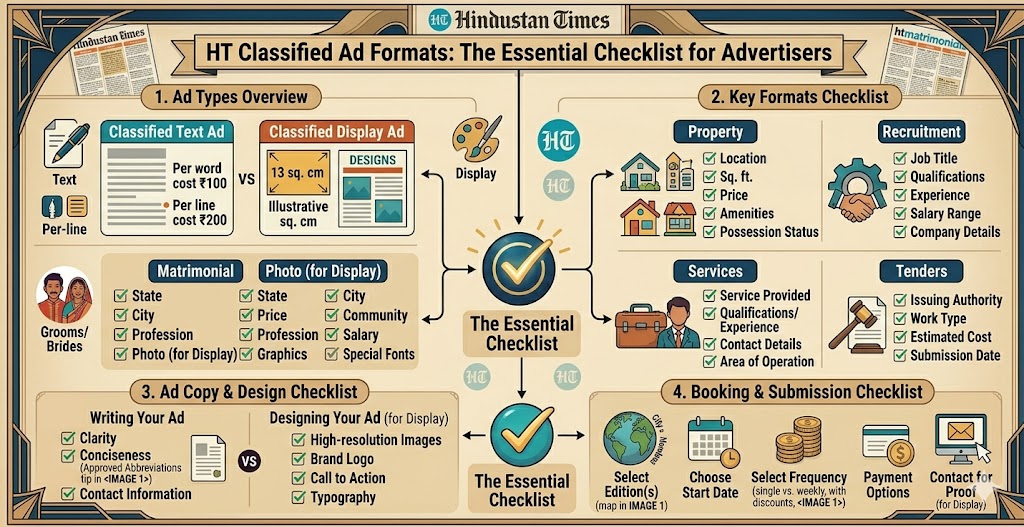
Yes, though they vary. Text classifieds are priced per word or line, so the limit is effectively economic — longer costs more. Display classifieds are sized by column width and centimetres.
For legal notices, there's no hard character cap, but the newspaper may flag unusually long text ads for editorial review. Call the booking desk with your draft if you're uncertain.
Q7: Can I use abbreviations in my HT classified ad to save money?
For personal ads — matrimonial, property, services — yes. Common abbreviations (S/O, D/O, W/O, Opp., Nr.) are generally accepted.
For legal categories — name change, public notice, lost document — be careful. If the ad is going to be used as legal proof, the accepting authority may not accept abbreviated text. When in doubt, write it out. The few extra rupees aren't worth a rejection from a government office.
Q8: How do I format a change of religion ad in Hindustan Times?
Similar structure to a name change ad. Full name, parentage, current address. Then: "I, [Name], hereby declare that I have voluntarily converted/changed my religion from [Previous Religion] to [Current Religion] with effect from [Date]."
Some states require publication in both an English daily and a regional language daily. Check the requirement for your state before booking only one paper.
Q9: What's the standard size for a public notice in HT?
Depends on what the notice is for. For text-only public notices, there's no fixed minimum — but a notice that's too brief may not satisfy judicial requirements. Courts want to see that all relevant details are present, not just that publication happened.
Q10: Where can I find templates for Hindustan Times classified ads?
The HT Classifieds booking website has category-specific format guides. The booking desk can also send sample formats on request — especially for legal categories.
One honest caution: templates found on random websites may be outdated. Verify any template against the current guidelines before using it.