- Homepage
- Media Buying Agency
- What Does a Digital Media Buying Agency Do? Full Funnel Strategy Explained
What Does a Digital Media Buying Agency Do? Full Funnel Strategy Explained
What Does a Digital Media Buying Agency Do? Full Funnel Strategy Explained
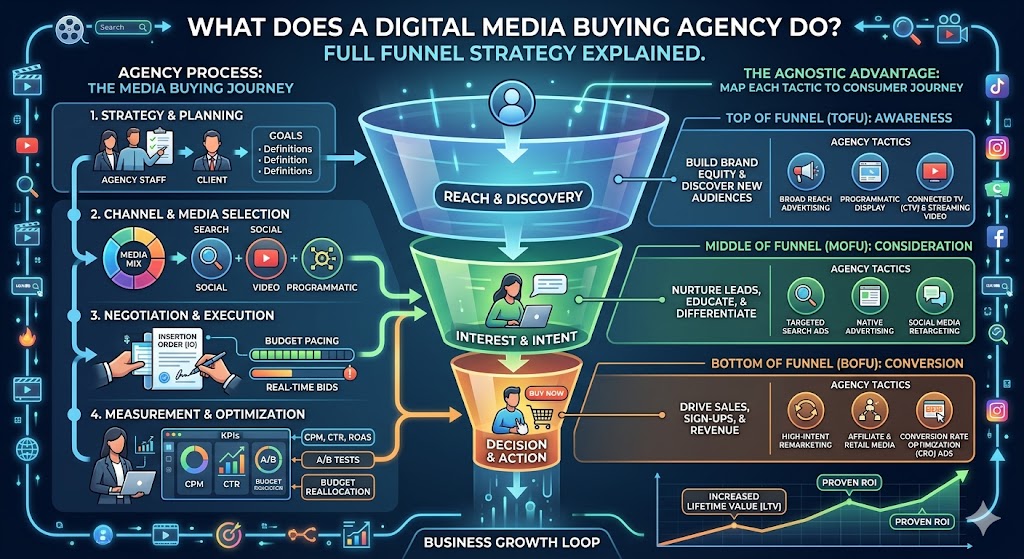
A digital media buying agency strategises, buys, and optimises the paid advertising position on digital platforms on behalf of a brand the aim of which is to achieve the correct audience, at the correct time, at the lowest cost that works. When you have ever wondered how a media buying agency works or what the full-service media buying agency services actually covers, this guide is a step by step account: beginning with the first audience insight to the last revenue report.
- 1. What Is a Digital Media Buying Agency?
- 2. How Does a Media Buying Agency Work?
- 3. What Does a Digital Media Buying Agency Do — Full List of Services
- 4. Full Funnel Strategy — How a Media Buying Agency Builds a Campaign
- 5. Full Funnel at a Glance — Budget Allocation Guide
- 6. What Full-Service Media Buying Agency Services Include vs What They Do Not
- 7. Who Needs a Full-Service Media Buying Agency?
- 8. FAQ — What Does a Digital Media Buying Agency Do?
What Is a Digital Media Buying Agency?
A digital media buying agency refers to a professional company that sells paid media on behalf of brands and companies. The mandate of a media buying agency is clear-cut unlike that of a general digital marketing agency which spans SEO, content and social media management: make any rupee or dollar of ad spend work as hard as possible on paid channels.
The agency is the intermediary between the funds of a brand and the channels, publishers, and networks in which its target markets spend their time. It introduces three components that are hard to establish in-house by most brands: platform expertise, purchasing relationships, and scale of performance data.
How Does a Media Buying Agency Work?
To begin with, to understand the work of a media buying agency, one has to learn about its workflow of brief to buy to optimisation.
Step 1 — Client Brief and Goal Setting The agency spends time learning about the business goal of the brand. Is it leads, ecommerce, app, store, or brand awareness? The objective dictates all the downstream decisions on channels, formats, budgets, and KPIs.
Step 2 — Audience Research and Segmentation The agency determines the target customer, i.e., their demographics, interests, behaviours, and intent signals, as well as their device usage patterns. It breaks the audience down into the funnel levels of cold prospects that have never heard of the brand, warm audiences that have expressed interest and hot audiences that are about to convert.
Step 3 — Channel Planning.According to the data on the audience and the objective, the agency suggests the appropriate mix of channels. All brands do not require all platforms. Google local search and Meta geo-targeting should be used by a local service business. A D2C brand requires Meta prospecting, Google shopping and youtube retargeting. The channel plan aligns every platform with a particular funnel stage and goal.
Step 4 — Media Buying and Campaign Setup The agency negotiates and buys the media programmatic inventory, platform ad placements or direct publisher deals. It creates campaigns, ad sets, audiences, creatives, tracking pixels, UTM parameters, and conversion events. Here strategy is implementation.
Step 5 — Launch, Monitor, and Optimise Campaigns become live. The performance the agency monitors on a daily basis includes: spend pacing, CPL, CPA, ROAS, frequency, and creative fatigue. It optimizes bids and redistributes budget to the most performing audiences and placements, replaces creatives, and removes waste.
Step 6 — Reporting and Strategy Review Weekly summaries and monthly performance reports are used to convert data into decisions. The agency determines what is working, what is not, and the next strategic step should be expanding a successful audience, experimenting with a new channel or changing the creative strategy.
What Does a Digital Media Buying Agency Do — Full List of Services
Full service media buying agency services cut across the entire paid media lifecycle. This is what a thorough agency encompasses.
Media Strategy and Planning
- Stage by stage audience research and persona mapping.
- Analysis of the competitive media landscape.
- Selection of channel and budget allocation at the platforms.
- Planning the seasonality and the campaign calendar.
- Funnel building - awareness, consideration and conversion layers.
Media Buying and Inventory Management
- Programmatic purchasing Display, video, native, and CTV/OTT inventory through DSPs (Demand-Side Platforms).
- Direct deals with publishers on premium placements.
- Ad purchase in social media - Meta, Instagram, YouTube, LinkedIn, Snapchat, Pinterest.
- Search media buying Google search, Google shopping, Microsoft ads.
- Local or regional OOH purchasing, out of home and on-line.
- Purchase of print and radio media where necessary (traditional media)
- Negotiating the rates and optimising inventory.
Campaign Setup and Technical Execution
- UTM structure of parameters and taxonomy of campaigns.
- Audience building, custom audiences, lookalike audiences, retargeting pools.
- Dynamic creative setup Dynamic product ads, responsive search ads.
- A/B and multivariate creative testing systems.
- Landing page QA — tracking and pages load in a short time on mobile are both working.
Campaign Optimisation
- Pacing daily expenditures and redistribution of the budget.
- Bid strategy management - manual, automated, target CPA, target ROAS.
- Growth of audiences and performance-based pruning.
- Frequency and creative rotation to avoid ad fatigue.
- Placement-level analysis and exclusion.
- Search campaign negative keyword management.
Analytics, Attribution, and Reporting
- Performance reports (weekly): expenditure, impressions, clicks, CPL, CPA, ROAS.
- Monthly strategy reports: what has worked, what has not, and change of next month.
- Attribution modelling first- click, last- click, data-driven or multi-touch.
- Tracking of revenue and customer acquisition cost (CAC).
- Dashboard configuration to show the client real-time campaign performance.
Advanced and Specialist Services
- Programmatic audience data strategy First-party, second-party and third-party data activation.
- OTT media buying and Connected TV (CTV).
- Digital out-of-home (DOOH) purchasing and geo-fencing.
- Influencer media amplification - increasing the content of the creator as a paid ad.
- SMS and WhatsApp remarketing through paid traffic trigger.
- Management of frequency capping cross-channel and brand safety.
Full Funnel Strategy — How a Media Buying Agency Builds a Campaign From Top to Bottom
The greatest factor that makes a good media buying agency and a poor one is the fact that they either think in funnels or they think in single campaigns. Full funnel strategy implies that each advertisement has an intention related to a particular step in the buyer process - and each step provides another.
Top of Funnel — Awareness
Goal: Find the people who were not aware of your brand and create a sufficient level of recognition to make them ready to cooperate when they see you again.
Channels used: YouTube pre-roll, Meta and Instagram reach campaigns, programmatic display, Digital OOH, Reels and Stories, podcast ads, CTV.
Formats:Short video (6 to 15 seconds), high-impact display, native content ads
KPIs: Reach, frequency, video view rate, cost per thousand impressions (CPM), brand lift (when the budget is bigger)
Agency's role at this stage: Audience research, media plan, creative brief direction, and purchase of the correct inventory at the correct CPM. The agency will make sure that you have the right cold audience and will not pay high to reach out.
Middle of Funnel — Consideration
Goal: Rerelease those people who have demonstrated an interest in your brand in the top of the funnel or have demonstrated intent signals they have been on your website, have watched a video, have interacted with a post and provide them with a reason to explore more.
Channels used: Meta retargeting, Google display retargeting, YouTube remarketing, email lists based custom audiences, LinkedIn B2B.
Formats: Carousel advertisements, longer video (30-60 seconds), testimonial advertisements, comparison advertisements, lead generation forms.
KPIs: Click-through rate (CTR), cost per landing page view, lead form completion rate, video completion rate, time on site.
Agency's role at this stage:Retargeting pools of visitors to the site, video viewers, and pools of engagement. Sequencing creatives to have somebody who watched your awareness ad now sees a more targeted message: a product demo, a review, a particular use-case etc.
Bottom of Funnel — Conversion
Goal:Turn warm audiences with high intent into paying customers or leads or installs.
Channels used: Google Search (with the highest intent) Meta conversion campaigns, Google Shopping to ecommerce, Dynamic Product Ads (DPA), and call-only ads to local services.
Formats: Search text advertising, dynamically created product advertising, offer-based creatives, urgency-based copy, click to call.
KPIs: Conversion rate, cost per acquisition (CPA), cost per lead (CPL), the cost per ad spend, and revenue attributed.
Agency's role at this stage: Tight audience segmentation - reaching out to only the warmest signals. Bid optimization to conversion events. Action, action all the way, creatives. Bad audience block to prevent burns on current clients.
Post-Conversion — Retention and Upsell
Goal: By refining customers who have already converted, maximise the lifetime value of those customers, by re-introducing them to repeat purchases or upsell opportunities.
Channels used: Meta custom audiences based on customer lists, Google Customer Match, email-based ad retargeting, WhatsApp broadcast amplified with paid.
Formats: Loyalty offers ads, creative advertising to current buyers to promote a new product, referral ads.
KPIs: Customer lifetime value (CLV), Repeat purchase rate, cost per repeat acquisition.
Agency's role at this stage: The agency needs to suppress existing customers so cold acquisition campaigns do not go to waste, and needs to run another layer of retention that generates repeat revenue. This level is usually overlooked by brands yet it has the best ROAS of any funnel level.
Full Funnel at a Glance — Budget Allocation Guide
|
Funnel Stage |
Typical Budget Allocation |
Primary Channels |
Primary KPI |
|
Awareness (Top) |
20 – 30% |
YouTube, Meta Reach, Programmatic, OTT |
CPM, Reach, Frequency |
|
Consideration (Mid) |
25 – 35% |
Meta Retargeting, Google Display, YouTube |
CTR, CPL, Engagement Rate |
|
Conversion (Bottom) |
35 – 45% |
Google Search, Meta Conversion, Shopping |
CPA, ROAS, Revenue |
|
Retention (Post-Buy) |
5 – 15% |
Customer Match, Email-Triggered Ads |
Repeat Purchase Rate, CLV |
Budget allocation changes depending on the maturity of the brand. The brand with zero awareness requires a greater investment on the top of the funnel first. An established brand with high organic traffic can allocate more budget to conversion and retention with the highest ROAS.
What Full-Service Media Buying Agency Services Include vs What They Do Not
Knowing what is and is not in scope prevents misaligned expectations before you sign a contract.
|
In Scope |
Out of Scope |
|
Paid media strategy and planning |
Organic SEO and content creation |
|
Campaign setup across paid platforms |
Social media management (organic posting) |
|
Audience research and segmentation |
Website development and UX redesign |
|
Creative briefing and performance feedback |
Email newsletter creation and management |
|
Media buying and rate negotiation |
Influencer talent identification and contracting |
|
Campaign optimisation and bid management |
PR and earned media |
|
Performance reporting and attribution |
Brand identity and logo design |
|
Tracking and pixel setup |
CRM setup and management |
A few full-service media buying agencies also go as far as creative production, such as ad copywriting, (static) design, and video editing of paid formats. Before you assume that creative is a part of your particular agreement, always be clear what is and is not encompassed in your agreement
Who Needs a Full-Service Media Buying Agency?
Not all brands will require a full-service agency in the beginning. This is a short tutorial on when it is appropriate.
You need a full-service media buying agency if:
- You are or you are intending to run paid campaigns in three or more platforms at the same time.
- The size of your monthly advertisement budget is 100,000 or above.
- You require programmatic, CTV, or OTT inventory that necessitates DSP accessibility and specialist purchasers.
- Your existing campaigns are operating but the ROAS is lower than you want and you are not able to find out why.
- You want to expand out of one market or one channel to multi-city or multi-channel campaigns.
- You require a methodical entire funnel strategy and not one a burst campaigns
A specialist single-channel agency or in-house hire may be enough if:
- Your ads are only being placed on a single platform at low spend.
- Your business concept is straightforward,so all you need is search intent to convert.
- You have an in-house team that can do the implementation and just need strategic direction.
FAQ — Media Buying Agency vs Digital Marketing Agency
What is the main difference between a media buying agency and a digital marketing agency?
A media buying agency focuses only on paid advertising. They plan, purchase, and optimise ads on platforms like Google, Meta, YouTube, and programmatic networks. A digital marketing agency offers a wider range of services such as SEO, content marketing, social media management, email marketing, along with paid ads. The main difference is focus: media buying agencies go deeper into paid ads, while digital marketing agencies cover more overall marketing channels.
How does a media buying agency work on a day-to-day basis?
A media buying agency checks the spend pacing and platform performance dashboards on all the active client campaigns on a particular day. It verifies creative exhaustion - advertisements whose click-through rate is dwindling - and switches to new versions. It also checks the performance of the audience and forwards budget to segments that are doing better. It raises red flags in conversion tracking and fixes them before they can influence the accuracy of reporting. Each week, it gathers the performance summaries and draws strategic recommendations.
What channels does a full-service media buying agency manage?
Full-service media buying agencies usually handle Google Search and Google Shopping, Meta and Instagram, YouTube, programmatic display and video (through DSPs), LinkedIn when it comes to B2B, with an increasing number of Connected TV (CTV) and Digital Out-of-Home (DOOH). There are also agencies that deal with traditional media television, radio, and print as an integrated brand campaign. It is a matter of the channel mix that will be determined by your audience, objective, and budget.
What is programmatic media buying and does my brand need it?
Programmatic media buying is the automated acquisition of display, video, native and CTV ad inventory using software systems known as Demand-Side Platforms (DSPs). The agency does not negotiate with publishers, instead, using data signals to purchase individual ad impressions in real-time, targeting the right user no matter what the site or app they are on. Programmatic is required of your brand when you would like to reach outside of Meta and Google, advertise to niche audience segments using first-party data, or conduct CTV and streaming video campaigns. It becomes very cost-effective at budgets of 2,00,000 and up monthly.
How do I measure whether my media buying agency is doing a good job?
Compare with the KPIs that were agreed upon: ROAS, CPL, CPA, and revenue that can be assigned to paid media. On top of numbers, consider how fast the agency reacts when performance declines, their ability to articulate what is driving performance, and whether they are aggressively pursuing new ideas. An effective agency will increase the ROAS quarter to quarter, have a transparent communication channel and will never give you an eye roll as to the direction of where your budget is going.
What is the difference between a media buy and a campaign?
A media buy refers to the acquisition of a certain Ad inventory (placement, time slot, or amount of impressions) on a platform or publisher. The media buy is part of a campaign, the broad strategic framework of the creative, audience, objective, budget, and measurement framework. A media buying agency is concerned with both: strategic campaign architecture and tactical execution of a particular buy in it.
How long does it take a media buying agency to show results?
The majority of campaigns require 30-60 days to leave the learning stage and begin to give optimised results. Significant ROAS benchmarks can be achieved in week six to eight. Full funnel strategy - in which awareness campaigns lead to consideration and conversion - may take three to four months to compound results as one phase starts to feed others. Watch out against agencies that claim high ROAS in two weeks without a rigorous learning process.
What should I give a media buying agency to help them get started faster?
Provide your customer information (email lists, CRM exports, purchase history) to build your audience. Provide access to your Google analytics and web pixel data to allow the agency to create retargeting audiences at once. Write a clear brief: what you need to achieve, your monthly budget, your target CPL or ROAS, and focus audiences or geographies. The more the context, the quicker the agency becomes set up and optimised.
Conclusion
There is much more than just placing ads in a digital media buying agency. It studies your audience, creates a full funnel program covering awareness, consideration, conversion and retention, purchases media on the right channels at the right price and will optimise all variables, bids, creative, audience and placement until you see your budget working at maximum efficiency. Full service media buying agency services include all the paid media lifecycle of the agency strategy all the way through to reporting and the value of the agency is determined based on how briefed it is and the definition of success. In the event that paid advertising is one of the major growth drivers in your brand, it is only natural that you familiarize yourself with the way a media buying agency works before you can get more out of every rupee you spend.

You Might Also Like