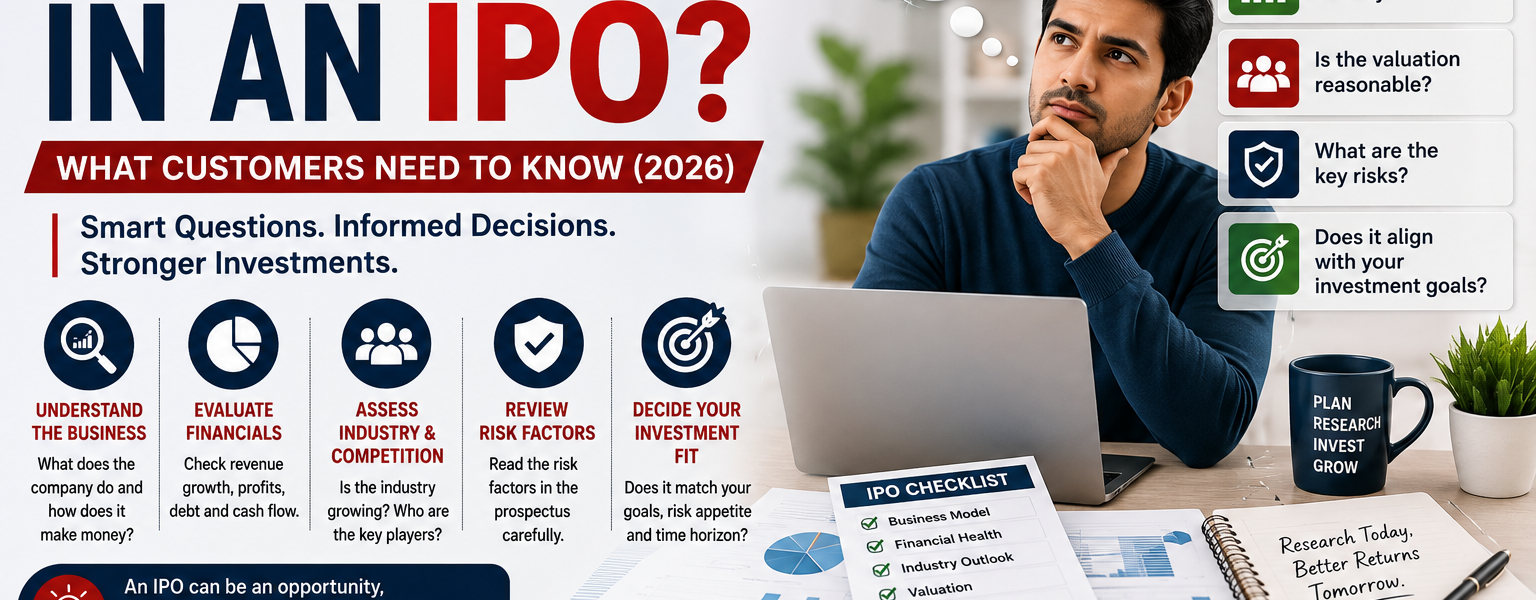
The most common problem with new high-profile companies to become public is: should I invest in an IPO? The truth is that a stock bought through an IPO investment is not riskier or safer than any other type of stock. It depends on the company's fundamentals, valuation and your own risk tolerance. In this guide, we will explain what you should consider before making your decision.
What Is an IPO, and Why Does It Attract So Much Attention?
IPO stands for initial public offering, and it attracts a lot of attention.
An Initial Public Offering (IPO) is when an unpublic company offers its stock to the public for the first time, typically to fund expansion, pay off debt or fund new projects. It's a rarity because it is the first time they have the opportunity to invest in a company at its initial offering price — but it's also what makes so many investors believe it is a remarkably safe investment.
An IPO is an investment occasion that allows a retail investor to be a part of a company's stock market debut, but the term 'first day access' is not synonymous with 'guaranteed opportunity'.
Is Investing in an IPO Actually Risky?
Yes, all IPOs have a risk. No matter how much regulation is present. The primary risks associated with the IPO investment include uncertain first-day price movement, valuation that may already price in optimistic growth, and limited trading history to judge the stock against.
In the last ten years, SEBI has taken meaningful steps to provide the investors with investor protection measures such as better promoter lock-in provisions, increased speed of refund process, and enhanced disclosure requirements etc. which have made the process more transparent. However, none of these safeguards ensure that the stock will perform well after going public.
What Do 2026 Market Numbers Actually Show?
A recent number of facts provide a useful dose of reality for IPO hype. Indian firms have so far collected around ₹1.83 lakh crore through 108 key listing problems, and the demand from investors has been high across the board, but the median returns on the key issues were only 3.8%. There were several IPOs that had a strong day on the first day that later dipped below the issue price within months. 2026 through June also saw retail subscription levels lag far behind institutional demand, with retail investors, in particular, being much more reserved than their institutional and HNI counterparts, primarily because of valuation concerns.
The takeaway: oversubscription and excitement on the day when a stock goes public aren't good signs of future success.
What Should You Actually Check Before Investing in an IPO?
Do not subscribe to any IPO, but follow these checks:
- Business fundamentals — Is the company profitable, or burning cash with no clear path to profitability?
- Use of IPO proceeds — Is the money going toward growth, or mainly to let existing investors and promoters cash out (an Offer for Sale)?
- Valuation — Does the price-to-earnings or price-to-sales ratio look reasonable next to listed peers in the same sector?
- Promoter lock-in and governance — Are promoters restricted from selling immediately after listing, and is the leadership track record clean?
- Sector and macro backdrop — Is the business tied to a cyclical or policy-sensitive sector where earnings could swing sharply?
How Much of Your Portfolio Should Go Into IPOs?
While there is no universal number, multiple market analysts who have covered the IPO cycle this year from 2025-2026 have arrived at a similar conclusion of not using IPO applications as an investment strategy. It will be somewhat like limiting IPO exposure to roughly 5–10% of your total equity portfolio. This ensures that one disappointing listing day won't significantly impact your overall returns.
| Investor Type |
Suggested Approach |
| Conservative investor |
Skip most IPOs; consider only well-established, profitable companies with reasonable valuations |
| Balanced investor |
Apply selectively, cap IPO exposure around 5–10% of equity portfolio |
| Aggressive investor |
Participate more broadly, but track post-listing performance closely rather than assuming gains |
Is Applying for IPO Shares the Same as Buying on the Stock Exchange?
No. These are two different processes having different risk profiles.
- IPO application: Application for shares before listing, either at a fixed price or in the range of prices announced for the listing. You will not be allotted if there is an oversubscribed issue, and if you are not allotted your blocked funds are released.
- Buying after listing: When the stock begins trading, the purchaser will enter the stock at whatever market price it trades at that day, which may be much higher or lower than the issue price, depending on the day's sentiment.
Retail investors are also allocated shares proportionately when an issue is oversubscribed and full allotment is not guaranteed even with an application as retail application limits are capped which were historically around ₹2 lakh per application in India.
Do IPO Listing Gains Guarantee Long-Term Returns?
Gains on the listing day are not really related to long term performance. If the underlying business does not grow its valuation the stock may rally on its first day and fail to keep up the year after. How exciting the listing day was is less significant than long-term outcomes, which are closely tied to how the sector does, its governance and growth of earnings.
Common Mistakes First-Time IPO Investors Make
- Applying based on subscription numbers alone — high oversubscription reflects demand, not business quality
- Ignoring the use-of-proceeds section — an IPO that's mostly an Offer for Sale benefits existing shareholders more than the company itself
- Treating listing-day gains as the goal — this encourages flipping rather than evaluating the business
- Overconcentrating in one IPO — putting a large share of your portfolio into a single new listing multiplies risk
FAQ: IPO Investing Questions Answered
Should I invest in an IPO?
It depends on the company's metrics, valuation, and your risk limit. Examine every IPO offer on its own facts rather than following market noise.
Is an IPO safer than buying a regular stock?
No. An IPO stock carries standard market risks. It also brings added risk from a short trading record and price swings on listing day.
How much money do I need to invest in an IPO?
Your cost depends on the lot size and the IPO price band. Under SEBI rules, retail buyers can apply for up to ₹2 lakh per application.
Can I lose money on an IPO?
Yes. If the share lists below its issue price or drops later, you lose money like with any regular stock.
What percentage of my portfolio should go into IPOs?
Many market analysts suggest capping IPO investment exposure at 5–10% of your total equity portfolio. Do not use public offers as your main strategy.
Do high subscription numbers mean an IPO is a good investment?
Not always. Heavy demand shows high market interest, but it does not prove business quality or fair pricing.