India's ₹93,156 Crore Ad Market Finally Counted MSMEs — The Numbers Are Staggering
PMAR 2026 officially recognises MSME advertising as India's largest and fastest-growing ad segment. Here is what the data reveals, why it matters, and what comes next for small business advertising in India.
Every week, a brief lands in our inbox. A local D2C brand has an ₹8 lakh budget. They want outdoor ads in three cities and a push on Meta. They have no agency on retainer and no media team. The founder simply knows that advertising works and wants to do it right. We have handled thousands of briefs like this over thirteen years, since 2012.
The PMAR 2026 report recently named MSME advertising as the largest and fastest-growing segment in India. When it did, it did not surprise us — it simply confirmed what we see every day. The report calls this segment "The Invisible Majority." We have served these businesses since we were founded.
The Scale of What We Are Talking About
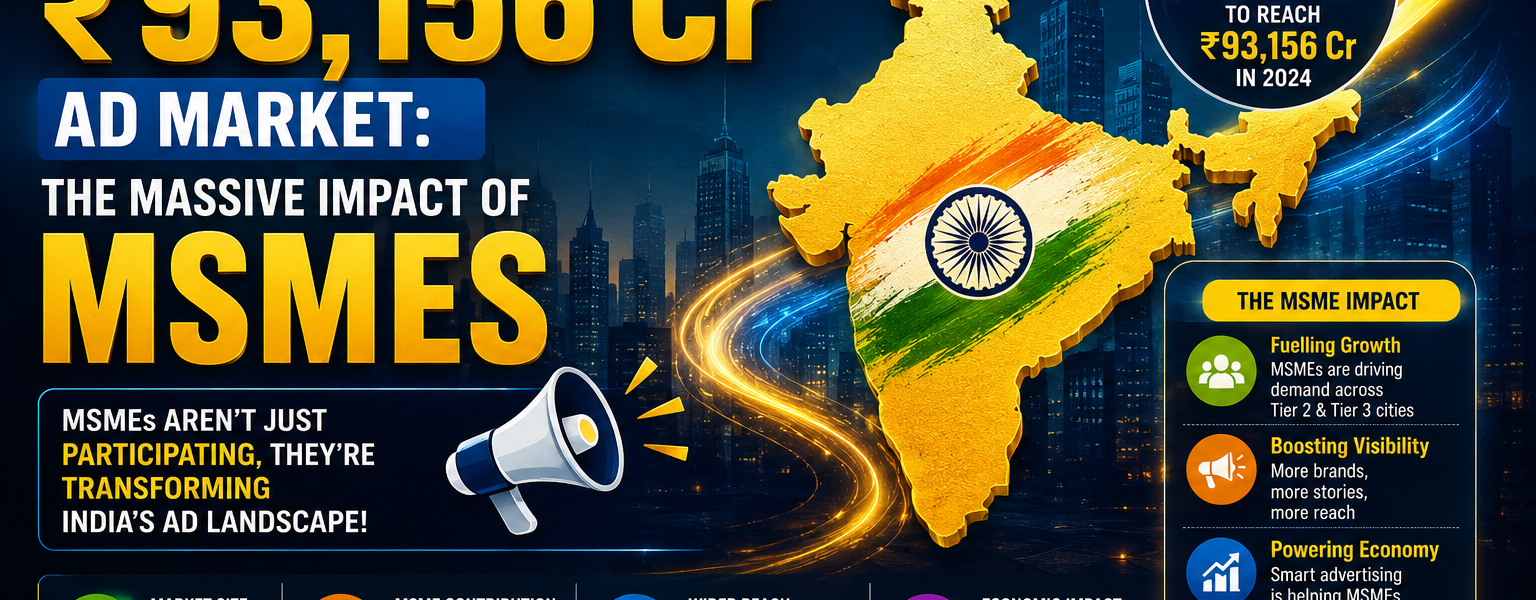
India has 63 million MSMEs. They contribute 30% of GDP and employ over 110 million people. For a long time, the official ad industry left this group out of all formal accounting tables. Meanwhile, MSME advertising grew at a remarkable pace.
The numbers are clear. India's digital advertising market is worth $10 billion today and is projected to reach $25–$30 billion by 2030. The future of advertising depends on bringing more new advertisers into the market — not simply extracting larger budgets from established brands. This is a fundamental shift in who advertises in India, and it is still accelerating.
63 Million MSMEs in India
30% of GDP contribution
110 Million+ people employed
What PMAR 2026 and DAN Are Actually Saying
The PMAR 2026 report revised its measurement methodology this year. It now includes MSME digital spend and quick-commerce advertising — two massive categories that had never previously been formally tracked. With these additions, India's digital advertising market reaches ₹93,156 crore, representing 60% of all ad spend. India is now a majority-digital ad economy.
The MSME growth figures stand out clearly:
MSME advertising grows at 21% per year.
The broader Indian ad market grows at 12%.
MSMEs are the primary engine of growth for the entire ad market.
Separately, the DAN Digital Report 2026 reaches the same conclusion. It identifies MSME digitalisation as a primary growth pillar for Indian advertising — alongside digital commerce and local manufacturing. The report highlights retail media, commerce advertising, and integrated digital marketing as the fastest-growing areas. These are precisely the spaces where MSMEs concentrate their spend.
Both reports point to four structural causes for this shift:
A new generation of digital-first business owners is prioritising performance advertising from day one.
Internet penetration in Tier 2 and Tier 3 cities is opening entirely new markets.
Self-serve ad platforms enable businesses to buy media directly, eliminating intermediary costs.
New D2C brands are using advertising as their primary route to market.
The two most authoritative reports in Indian advertising now confirm what we see in our inbox every single week.
What the Data Actually Shows on the Ground
Reports like PMAR and DAN capture the macro picture. They do not reveal how individual businesses allocate their advertising budgets at the operational level. Our own campaign data fills that gap.
We analysed 3,500 active brands and over 15,000 campaigns. The results challenge a common assumption — that an MSME only buys digital ads, perhaps a Meta campaign or two. The reality is considerably more sophisticated.
Traditional Media: 41% of our MSME campaigns include outdoor hoardings, print, radio, and cinema advertising. These businesses deliberately choose offline media for fast, localised reach.
Television: 5% of campaigns include TV advertising, yet these account for 15% of total spend. When a small brand commits to TV, it invests significantly.
Connected TV (CTV): Linear TV plus CTV grew by 3.7%. Connected TV allows brands with tight budgets to access premium ad inventory that was previously out of reach.
Over 50% of MSME campaigns incorporate offline media. More than 55% of total budget value flows into digital and TV. The data reflects a smart, deliberate media mix strategy — not accidental fragmentation.
Why This Segment Was Invisible for So Long
PMAR frames this as a tracking issue — but the deeper cause is structural. The tools of traditional advertising were never designed for small businesses.
Large brands buy advertising for long-term brand equity. They plan campaigns years in advance. MSMEs buy advertising for immediate sales, customer footfall, and rapid growth. Every rupee must demonstrate a return, quickly.
The old advertising market required substantial budgets, months of planning, and significant agency fees. MSMEs did not stop advertising because of this. They relied on local media brokers and self-serve digital platforms instead. Their collective ad spend was substantial, yet it never appeared in any official ADEX table.
The old market was designed to serve a handful of large buyers. The new Indian advertising market has millions of small, fast-moving buyers who demand speed, low entry costs, and complete transparency.
What Infrastructure Looks Like When Built for This Segment
The Media Ant treats media buying as accessible, essential infrastructure. We built this platform specifically to close the gap for small businesses.
Our scale reflects the opportunity. We offer 3.5 lakh advertising options across 12 media verticals, managing 3,500 active brands and over 15,000 campaigns.
Traditional media buying depended on relationships and connections. Our platform replaces that dynamic with transparent, data-driven buying. An MSME founder in Nagpur can now access the same high-quality media options as a major national brand. Platforms that simplify media discovery have become critical infrastructure for business growth in India.
The Next Problem: Intelligence at Scale
Finding advertising options is no longer the challenge. The real problem is planning the campaign intelligently.
A growing business faces over 3.5 lakh media choices — a volume that can feel paralyzing. Which media mix is right for your category? How do you split budget between outdoor and digital? A campaign in Pune requires a fundamentally different plan than one in Patna. How do you reach new customers without exhausting your quarterly budget in three weeks?
These are legitimate, consequential questions. Building a media plan manually, however, can consume weeks of a founder's time — time already committed to managing daily operations, teams, and supplier relationships.
This is the precise problem that Ant10 solves. Our new AI-powered media planning assistant is currently in its final testing phase.
The process is straightforward. Enter your goal, target city, audience profile, and advertising budget. Ant10 analyses data from thousands of past campaigns across comparable markets and generates a complete, actionable media plan in minutes.
Our goal is straightforward: a brand with a modest budget should receive the same quality of media planning as a large corporation. Good strategy should not depend on the size of your budget.
PMAR 2026 confirms that small businesses are the fastest-growing advertising segment in India. Ant10 exists to help millions of these founders plan smarter campaigns with confidence.
What This Shift Means for the Indian Advertising Industry
ETBrandEquity's coverage of PMAR 2026 issued a clear directive to advertising leaders: invest budgets with discipline, build connected systems, and act on real market data.
That is sound advice for legacy agencies. But a more fundamental transformation is already underway.
The fastest-growing businesses in India do not have a Chief Marketing Officer. They do not retain a large agency of record. They do not hold extended strategy sessions. They have a business problem, a defined budget, and a local market to win. They need an ad platform that lets them act immediately, without lengthy onboarding or agency dependency.
These business owners are now the new majority. PMAR 2026 makes that official.
This transformation is reshaping the entire advertising industry. The tools of the old model were designed for a handful of large clients with massive budgets. The new model demands tools built for millions of small advertisers — tools that offer low entry costs, rapid setup, and transparent performance tracking.
The Decade Ahead
The last decade democratised e-commerce. A business owner in a small town now accesses the same shipping infrastructure and logistics tools as a major retailer in Mumbai. The next decade will do the same for media buying.
Founders will have access to simple, powerful tools for media planning. Platforms will enable direct ad buying without relying on corporate relationships or legacy connections. Clear performance data will allow businesses to adapt their strategy the moment their market shifts.
These capabilities are no longer exclusive to large brands with outsized budgets. They are becoming standard business infrastructure — accessible to everyone.
We have spent thirteen years building for this moment. Modern industry reports now confirm what our clients have told us for years. The self-made business majority is finally visible. The advertising industry is changing rapidly to serve them.
The Media Ant is India's largest self-serve media planning and buying platform, with 3.5 lakh advertising options across 12 media verticals. Ant10, its AI-powered media planning assistant, is currently in development.
Kohelica Nag is a creative writer in Riyoadvertising.com in branding, social causes, public announcements and finance. She is known to explain complicated matters in simple terms and comes up with great, interesting content which guides businesses to be great brands, create a social impact, and comprehend financial complexities. Kohelica has the ability to look at things in a different way, and her work is very insightful and practical, which makes it a special perspective to any piece she writes. Her dedication to offering practical recommendations and straightforward plans renders her an irreplaceable asset to every person wishing to develop in these areas.