
Table of Contents
- ➜ Introduction
- ➜ What "Display Ad" Actually Means in TOI
- ➜ The Rate Card Structure — How TOI Prices Display Ads
- ➜ Times of India Display Ad Rates — City-Wise 2026
- ➜ Front Page and Premium Positions — The Numbers People Don't Ask For Until It's Too Late
- ➜ Display Ad Rates for Specific Categories
- ➜ Online Booking — and Whether the Rate Is Actually Lower
- ➜ What the Rate Card Doesn't Tell You
- ➜ Frequently Asked Questions
Times of India Display Ad Rates 2026 — What You're Actually Going to Pay
I've had clients come to me with budgets built around numbers they found on some aggregator site — numbers that were two rate cards out of date. They'd planned a campaign, got the approvals, and then the actual quote came in 30% higher. TOI updates its rate cards every year. Sometimes mid-year for specific categories. This guide uses figures verified against the April 2026 rate card (source: adrates.timesofindia.com, confirmed April 1, 2026). If you're reading this six months from now, check again before you commit.
The times of india display ad rates differ by city, by position, by day of the week, and by category. That's four variables before you've even decided on size. Most people don't realise this until the quote arrives.
What "Display Ad" Actually Means in TOI
Display ads in TOI are very different from classified text ads. They are not priced by the number of words. Instead, you pay for the physical space your ad occupies on the newspaper page.
The cost is calculated as: rate per sq cm × total ad size.
For example, a 10×15 cm ad equals 150 sq cm. If the rate is ₹800 per sq cm in the Mumbai main edition, the cost becomes ₹1,20,000 for just one day and one city. This is before adding any extra charges for premium placement.
This pricing may seem high, but TOI offers massive reach. It's important to understand this cost structure before deciding your ad size during planning.
The Rate Card Structure — How TOI Prices Display Ads
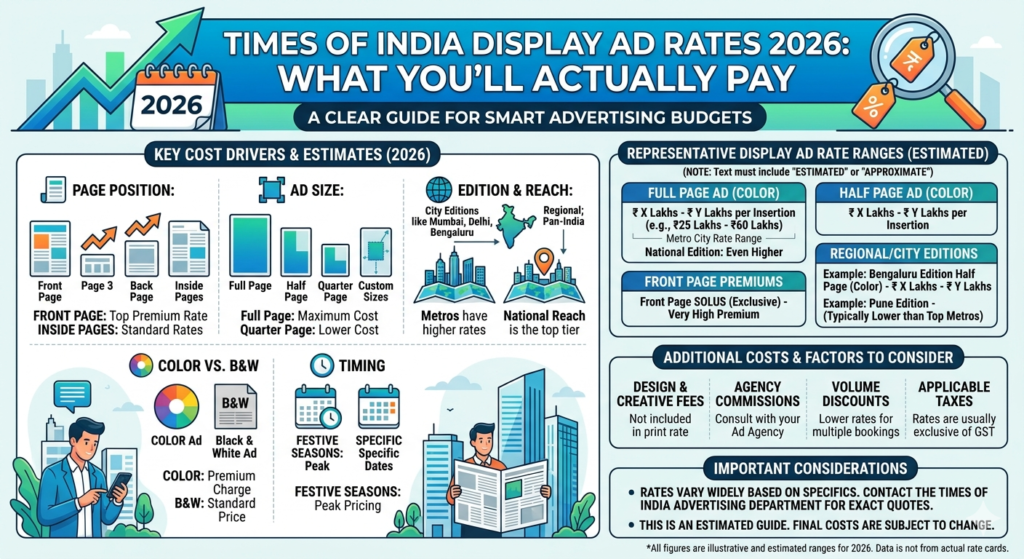
TOI display ad pricing is built on three main factors: city edition rates, position premiums, and day premiums. These are added together to determine the final cost.
The base price depends on the city. Metro cities like Mumbai, Delhi, Bangalore, Chennai, and Kolkata all have different per sq cm rates. Mumbai and Delhi are the most expensive. Tier-2 cities like Pune, Ahmedabad, and Lucknow are more affordable, sometimes costing 40% less.
Ad position also plays a major role. Front-page ads are not just slightly higher—they cost much more than regular pages. Ads on right-hand pages cost more than left-hand pages. Placing an ad above the fold on inside pages can increase the cost by 15–25%.
The day of publication matters too. Sunday is the most expensive because it has the highest readership. Wednesday is also popular, especially for recruitment and property-related ads.
Times of India Display Ad Rates — City-Wise 2026
Here are the approximate base rates per sq cm for TOI's main edition (without premium placements):
| City | Rate per sq cm | Notes |
|---|---|---|
| Mumbai | ₹760 to ₹900+ | General pages average around ₹800 |
| Delhi | ₹700 to ₹860 | Includes NCR coverage like Noida and Gurgaon |
| Bangalore | ₹500 to ₹620 | Prices have increased in recent years |
| Chennai | ₹420 to ₹540 | Competitive for education and property ads |
| Kolkata | ₹380 to ₹480 | One of the most affordable metro options |
| Pune, Ahmedabad, Lucknow | ₹280 to ₹420 | Good for regional campaigns |
These are starting rates. Final pricing can vary based on placement, section, and timing.
Front Page and Premium Positions — The Numbers People Don't Ask For Until It's Too Late
Front-page ads are priced separately and are usually negotiated.
In Mumbai, a front-page strip (bottom section) can cost between ₹8 lakh and ₹15 lakh for one day. A full jacket ad (covering front and back pages) starts around ₹40 lakh and can go beyond ₹48 lakh for Sundays.
Delhi front-page ads are usually 10–15% cheaper than Mumbai.
Other premium spots like the back page or Page 3 can cost 30–50% more than regular ads. Centre spreads (two full pages) are priced separately and usually require booking at least two weeks in advance.
If your total campaign budget is under ₹20 lakh, front-page advertising may not be practical.
Display Ad Rates for Specific Categories
Different categories use display ads differently.
Recruitment
Recruitment ads often perform well in the Ascent supplement (usually on Thursdays). These ads target professionals, making them more effective despite higher rates. Many companies find value in this for senior hiring roles.
Public Notices
Public notice ads are often overpaid. Display ads are priced the same as regular display ads, but most legal notices can be done through classified text at a much lower cost. Always check legal requirements before choosing display format.
Property & Education
Property ads perform best in weekend editions, especially in the Times Property supplement. Education ads see strong results during the admission season (June–July).
Overall, display ads in TOI are powerful but expensive. Choosing the right city, position, and category is key to making the most of your budget.
Online Booking — and Whether the Rate Is Actually Lower
Short answer: yes, in most cases. Times of India display ad rates booked online through platforms like riyoadvertising.com or releasemyad.com are usually 15–35% cheaper than walk-in counter rates. The discount for display ads is smaller compared to classifieds, where online discounts can go up to 50%. Display ads have tighter margins, so the price difference is not as high.
Another benefit of booking online is proper documentation. You receive a written rate confirmation before making the payment. With walk-in bookings, pricing discussions are sometimes verbal, and the final invoice may differ. This is not specific to TOI—it's common across many large media houses.
For display ads, the minimum booking lead time is usually five to seven working days for standard placements. If you want premium spots like the front page, you'll need to book at least two to three weeks in advance. A good strategy is to book in the last week of the month for ads planned in the following month. During this time, ad operations teams are more flexible with positioning since they are planning future inventory rather than filling immediate gaps.
What the Rate Card Doesn't Tell You
There are a few important details that are not mentioned in the official rate card.
Multi-City Combo Pricing
First, combo pricing across multiple editions is often negotiable. If you are booking ads in cities like Mumbai, Delhi, and Bangalore in the same week, you can ask for a multi-city rate. This pricing is not publicly listed, but it is available for larger campaigns.
Colour Ad Premium
Second, colour ads usually cost more. In most sections, choosing colour instead of black-and-white adds around 15–20% to the cost. However, this extra charge does not apply to pages that are already printed in full colour, such as the front page, back page, or certain supplements. If your ad is placed on an inside page that is normally black-and-white, you will have to pay extra for colour.
Bleed Ads
Third, bleed ads—ads that go right to the edge of the page without margins—come with a small additional cost. This charge is not always clearly mentioned upfront, so it's worth confirming in advance.
Agency Commission
Lastly, agency commission plays a role in pricing. Registered media agencies typically get around 15% off the rate card. If you are booking directly without an agency, you will need to negotiate your own discount. This difference is one of the main reasons why working with a media buyer can sometimes be more cost-effective.
Frequently Asked Questions
1. What are the times of india display ad rates per sq cm in 2026?
Mumbai and Delhi run ₹760–₹900 per sq cm for run-of-paper placement. Other metros are lower — Bangalore around ₹500–₹620, Chennai ₹420–₹540, Kolkata ₹380–₹480. TOI display ad cost per sq cm varies by section and day on top of the city base rate. Sunday adds a premium in every market. These are April 2026 figures verified against adrates.timesofindia.com — check before booking.
2. How much does a display ad cost in times of india for a half-page?
Depends entirely on the city and position. A half-page in Mumbai main edition at ₹800 per sq cm, run-of-paper, works out to roughly ₹2.4 lakh to ₹3.2 lakh depending on the exact dimensions. That's before any day premium or position charge. Right-hand page, above fold, Sunday would push that number considerably higher. Get a written quote. Don't build a budget off this number alone.
3. Is there a times of india display ad rate card 2026 PDF available?
TOI publishes rate information through adrates.timesofindia.com. A formal times of india display ad rate card 2026 PDFfor specific editions is available through authorised media buyers and directly from TOI's ad sales team. The public-facing page has indicative rates — the full card with position premiums and supplement pricing requires a direct request. We can pull the latest card for your target editions. One email, usually same-day response.
4. What are TOI display ad rates for recruitment advertising specifically?
Ascent supplement (Thursday) is the primary vehicle for recruitment display in TOI. TOI display ad rates for recruitment advertising in Ascent run at a premium over the base edition rate — roughly 10–20% higher in Mumbai. The readership is working professionals, which is why it costs more. For senior roles or volume hiring campaigns, it's worth the premium. For a single entry-level position, a classified text ad is cheaper and just as effective. Don't let anyone tell you otherwise.
5. Are times of india display ad rates lower when booked online?
Yes. Times of india display ad booking rates online are 15–35% below counter rates in most cases. Classified online discounts go higher — up to 50%. Display discounts are narrower but still real. Book through a registered platform for written rate confirmation before payment.
6. What's the lowest display ad rate available in Times of India?
Tier-2 city editions. Lucknow, Kanpur, Patna, Ranchi — lowest display ad rates in Times of India newspaper are in editions covering smaller markets, running ₹180–₹320 per sq cm depending on category and day. If your campaign targets those geographies, the cost-per-impression math is very different from Metro editions. Worth considering for regional product launches or local brand campaigns.
7. How do times of india display ad rates differ city-wise?
Mumbai and Delhi are the most expensive. Then Bangalore. Then Chennai and Kolkata roughly equal, with Kolkata slightly lower. Tier-2 editions are 40–60% cheaper than Mumbai. Times of India display advertisement rates city wise reflect both circulation and advertiser demand in each market — Mumbai commands the premium because that's where both the readership and the competition are densest. Check first. One phone call saves a lot of trouble.