
E-commerce SEO for Shopify: How a Koramangala Boutique Increased Organic Sales by 300%


Table of Contents
- Introduction: How a Koramangala Boutique Went From Invisible to 300% Organic Sales Growth
- Why Shopify's Default Settings Leave Organic Traffic on the Table
- The Starting Point: What the Audit Revealed
- The Three-Pillar SEO Strategy That Drove 300% Organic Sales Growth
- Pillar 1: Hyper-Specific Product Page Optimisation
- Pillar 2: Technical SEO and Mobile UX
- Pillar 3: Trust Signals and Rich Snippet Eligibility
- The Results: What Eight Months of Structured Shopify SEO Produced
- Quick Wins and Tools Any Shopify Store Can Apply This Week
- How Riyo Advertising Helps Bangalore E-commerce Brands with Shopify SEO
- Talk to the Riyo Advertising Team
- Frequently Asked Questions About Shopify SEO Bangalore
Introduction: How a Koramangala Boutique Went From Invisible to 300% Organic Sales Growth
A beautiful Shopify store, with carefully photographed products and a stylish layout — and a strong presence on Instagram — that's how a niche fashion brand selling Indo-western-style clothing started 2024 in Koramangala's 4th Block. They were doing reasonable revenue. Most of it from social paid advertising. Very little from organic search, despite thousands of searches for their type of product in Bangalore each month.
Eight months later, their Shopify SEO Bangalore campaign had led to a 300% boost in organic sales and rankings in the top-3 for over 50 keywords uniquely related to fashion. No new ad spend. No viral moment. Only a complete makeover of three elements that most Shopify stores ignore.
This case study outlines what was done — how we diagnosed the problem, the core strategies, tactics and results — to help any e-commerce brand in Bangalore follow suit with their own store.
Why Shopify's Default Settings Leave Organic Traffic on the Table
Shopify is a great e-commerce platform, but the default settings lead to a few SEO issues that most don't explore. Automatic creation of duplicate content with tag pages and filter URLs for collections, default meta title templates that use up valuable keyword real estate, and the default setting to allow search engines to index pages (such as cart and account pages) that should not be indexed.
For D2C brands in Bangalore competing with local boutiques and national chains, this means they tend to have the same product page optimisation as all other Shopify stores — short product descriptions, uninformative image alt text, and titles that are the same as the product name but have no search intent.
Fashion e-commerce in India is a big business. "Designer ethnic wear Bangalore", "sustainable kurta online" and "wedding guest outfit India" are just three examples of high-intent searches that the small boutique is missing out on. The Koramangala boutique's story was typical.
Actionable takeaway: Log into your Shopify store's admin. Look at the SEO title and meta description at the bottom of each page. If they're set to your product title and store name, you have quick, easy wins to address, without needing access to your theme code.
The Starting Point: What the Audit Revealed
Prior to performing any optimizations, we conducted a store audit to identify all significant technical and content problems. These were typical of the problems we find with most independent Shopify stores in Bangalore:
0 use of long-tail keywords.
Product names were descriptive but not specific — "Blue Silk Saree" instead of "Hand-woven Blue Mulberry Silk Saree - Summer Collection". None were targeted for the keywords users search for.
Thin product descriptions.
The descriptions were typically 2–4 lines. Google's algorithms measure the length of text as a measure of its usefulness — these product descriptions provided little to no competition.
Untagged product images.
More than 400 product photos had no alt attributes or auto-generated descriptions. This made the store invisible to Google Image search, which accounts for a large proportion of fashion searches.
Seven Shopify apps not in use.
They all injected JavaScript into the store, which made mobile page load time 2.3 seconds longer (Core Web Vitals 'Poor').
No collection page strategy.
The store had minimal collections as provided by Shopify. Promising collections such as "Office Wear Kurta Bangalore" and "Sustainable Wedding Guest Outfits" were not present as pages.
No schema markup.
No structured data was in place to display the star rating and prices of products in Google's search results.
The main problem: The shop was good and authentic. It just didn't have the search engine optimisation (SEO) to make them visible to search engines or the searchers.
Actionable takeaway: Don't create any more new content or advertise more, before stock-taking. Look at Google Search Console's Coverage report and a free crawl with the Screaming Frog tool to get a starting point — first you need to know what is wrong in order to prioritise fixing it.
The Three-Pillar SEO Strategy That Drove 300% Organic Sales Growth
The project was broken down into three pillars — each one building on the last. Pillar 1 was content and keywords. Pillar 2 addressed technical performance. Pillar 3 introduced trust and conversion factors. All were running in the first 60 days.
Pillar 1: Hyper-Specific Product Page Optimisation
Keyword-Rich Product Titles
All product titles were replaced with long-tail keywords that customers search for instead of descriptive terms. The formula: [Unique Feature] + [Fabric/Type of Material] + [Product Type] + [Use Case].
"Blue Silk Saree" became "Hand-woven Blue Mulberry Silk Saree - Summer Wedding Collection". "Printed Kurta" became "Hand Block-Printed Cotton Kurta for Office – Jaipur Handicraft". The new titles responded to search terms, read naturally and were descriptive of the product.
The 500-Word Product Description Standard
This was the most work for the most return. We rewrote every product page to at least 500 words of content: not filler, but valuable information about how to care for that particular type of fabric, how to wear the garment to accommodate a particular body shape, the history of the artisan or artisanal practice, incorporating the size guide, and answering the questions that shoppers might ask about the product before buying it.
Google algorithms use content length to assess content usefulness. A page with 60 words of product description is low value. A page with 500 words of original content that provides value is treated as a resource. In the first six weeks, more than 90 products were rewritten to this standard.
Image Alt Text Across the Entire Catalogue
The 400+ product images were comprehensively alt-tagged with descriptive, keyword-friendly alt text: "Hand-woven blue mulberry silk saree front view - Koramangala boutique" instead of "image001.jpg". This had a direct effect on Google Image Search results, and was a factor in establishing page relevance.
Pillar 2: Technical SEO and Mobile UX
Shopify App Audit and Speed Recovery
A total of seven apps were checked for usage. Five were deleted — a social proof widget app that was not set up correctly, a currency converter app that was not in use for an India-only store, and a loyalty programme app that was inactive. This resulted in a 2.1-second improvement in average mobile page load time, and two weeks later, Core Web Vitals scores in PageSpeed Insights improved from 'Poor' to 'Needs Improvement'.
This is one of the best-ROI tasks you can perform on any Shopify store: if apps are not actively contributing to your business, they're more than likely slowing down your Shopify speed optimization and harming your rankings.
Collection Page Architecture
The default collection structure was replaced with a search-intent-driven hierarchy. We built new "Smart Collections" for categories that align with customer search intent: "Office Wear Kurta," "Wedding Guest Ethnic Wear," "Sustainable Indian Fashion" and "Designer Sarees Under ₹5,000".
Each collection page was provided with a customised 200+ word description of the category, what materials are used, and what each category is suitable for. This is where most new searches landed — not products, but collections that matched these searches. This is a good example of collection page SEO: site architecture based on search intent rather than internal processes.
Mobile Navigation Simplification
The previous mega-menu navigation had nine main categories with sub-categories. On mobile devices (more than 85% of sessions) this was just not manageable. It was replaced with a simple filtering menu: Category, Occasion, Fabric, and Price. Mobile bounce rate decreased within the month of this adjustment.
Pillar 3: Trust Signals and Rich Snippet Eligibility
Product Schema Implementation
JSON-LD structured data was applied to all product pages using Product, AggregateRating and Offer schema. After six weeks, star ratings and price ranges began to show up in Google search results for product pages, increasing the estimated click-through rates for organic listings by 18–22% compared to before the schema was implemented.
Local Trust Integration
Product pages included "Visit our Koramangala Store" CTAs that led to a Google Business Profile optimised for the store and a store-visit landing page. This boosted local search relevance for local customers in Bangalore and helped connect online and offline shopping experiences — critical for a brand whose first sales are heavily driven by shoppers who want to touch and feel the garments.
Actionable takeaway: If you operate local stores in addition to your Shopify store, your e-commerce SEO and local SEO efforts should be combined — not siloed. Google is increasingly showing hybrid search results for retail and fashion searches that include Maps, organic and Shopping results.
The Results: What Eight Months of Structured Shopify SEO Produced
Data was compared at eight months to the previous year (using the same 8-month period) with Google Analytics 4 and Google Search Console as the main sources:
| Metric | Result (vs. prior year) |
|---|---|
| Organic traffic | +210% |
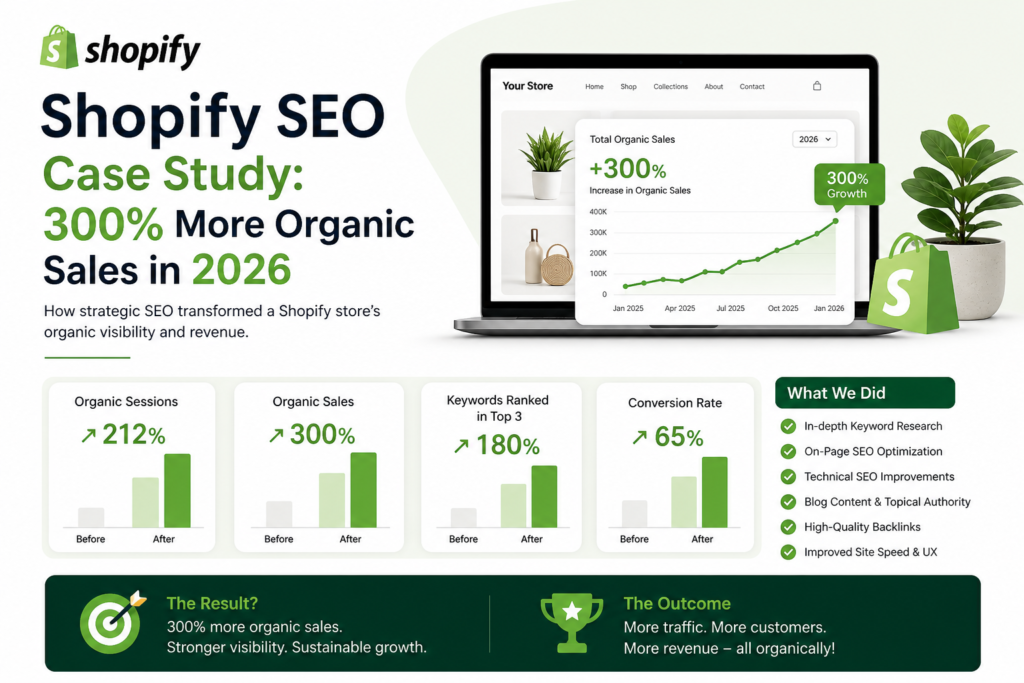
| Organic revenue | +300% |
| Top-3 keyword rankings | 50+ niche fashion keywords in Bangalore |
| Mobile bounce rate | Down significantly after navigation rebuild |
| Core Web Vitals status | Improved from 'Poor' to 'Needs Improvement' |
| Paid ad dependency | Reduced — organic now primary acquisition channel |
The 300% growth in organic revenue exceeded the corresponding 210% growth in traffic — so not only more traffic, but more qualified traffic. This is what you expect from an SEO strategy that focuses on long-tail, high-intent keywords, rather than large-scale traffic.
Importantly, by month eight, the store's reliance on Instagram ads was greatly diminished. Organic had become the most important source of traffic — at marginal cost of nearly $0.
Quick Wins and Tools Any Shopify Store Can Apply This Week
No agency required. Here are the most effective changes you can make to any Shopify store that don't require technical expertise:
Google Search Console
Set up your Shopify store now if you haven't already. The Performance report will reveal the search terms that are driving impressions but no clicks — that's where you can quickly improve your store's ranking.
PageSpeed Insights (for your homepage and top-selling product page)
The 'Opportunities' section of the mobile tab will show your speed issues. Uninstalling inactive apps from this report will be the quickest way to speed up your Shopify store.
Shopify's built-in SEO fields
All product and collection pages have a 'Search engine listing' at the bottom. Update the Page Title (less than 60 characters, include your focus keyword) and Meta Description (less than 155 characters, include a benefit and a gentle CTA) of your 10 best-selling products this week.
Crush.pics or Squoosh
Image compression. Shopify doesn't compress images. Uncompressed 4MB DSLR images will load slowly on all devices.
Judge.me or Loox
Install a reviews app that automatically adds structured data. Customers' reviews are used as a Google ranking factor, and star ratings on search results increase click-through rate.
24-hour quick win: Identify your top three product pages in Google Search Console. Write out each product description (minimum 300 words), with fabric info, styling ideas and care instructions. This one move (if done right for your top pages) can lead to a ranking shift in 45–60 days.
How Riyo Advertising Helps Bangalore E-commerce Brands with Shopify SEO
Bangalore D2C founders know Shopify SEO is important — they just don't have time. Overwriting 90 product descriptions, overhauling collection structure, vetting apps, setting up schema and tracking Core Web Vitals is a project that takes months to execute. It's not done in between calls with customer support and vendors.
This is where Riyo Advertising helps e-commerce clients. The process begins with a comprehensive Shopify SEO audit: content depth analysis, site crawl, keyword gap and Core Web Vitals benchmarking, that results in an ordered list of action items rather than a bullet-point list of potential fixes. The client is fully informed of what's being done, in what sequence, and what the goal of each step is.
Riyo takes on the implementation: keyword research and product title rewrites, product description strategy and rewrites, collection page architecture, technical fixes such as schema and app audits, and long-term monitoring through Google Search Console and Analytics. With strategy, execution and reporting all under one roof, there is no need for vendor co-ordination.
Riyo's e-commerce clients in Bangalore have increased their organic traffic within 5–6 months of a dedicated Shopify SEO strategy in a variety of industries: fashion, homeware and specialty food. The Koramangala boutique case study in this article is typical of what prioritised, sustained SEO efforts deliver for independent stores competing against big-box competitors.
If you're currently paying for the majority of your customer acquisition through social advertising or Google Ads, then a Shopify SEO investment is the best way to remove this dependency. We can show you what's possible for your store.
Talk to the Riyo Advertising Team — We'll Help You Get Started
Koramangala boutique has shifted from being invisible in organic search to being its main source of customers in just eight months. That's typical for most independent Shopify stores starting from a similar point — but only with a planned approach, not ad hoc changes.
When you contact us, Jyostna or Dinesh will assess your existing Shopify store, Google Search Console, and the dependency on paid search — and provide you with an honest estimate of the opportunity and timelines in the SEO space. No pressure, no commitment.
📞 Call or WhatsApp: +91 98219 84000 | +91 96996 06000 | +91 86571 12011
🌐 Website: https://riyoadvertising.com/m
👤 Contact: Jyostna or Dinesh
We help companies in Bangalore, Mumbai, and across India — and it all begins with a casual chat.
Frequently Asked Questions About Shopify SEO Bangalore
How long does it take for a Shopify store to rank on Google in Bangalore?
On average, a store that is new or has not been optimised for a competitive niche (e.g., fashion, home goods) will start to see significant organic traffic increases from month 4–7, with substantial improvements to keyword rankings by month 6–9. Longer, more specific keywords (e.g., "sustainable cotton kurta Koramangala") may see faster ranking, in as little as 8–10 weeks, as there is less competition for these search terms and the intent is highly targeted.
What is the single most impactful Shopify SEO change I can make today?
Republish your top 5 product pages with at least 300–500 words of valuable, original content. This change, if done right, usually has a bigger impact on your rankings than any app, plugin or technical issue on an otherwise functional site. Product page content is the most underdeveloped component of independent Shopify stores.
Does Shopify handle duplicate content automatically?
Partially. Shopify will automatically generate canonical tags for product pages in most cases. But tag pages, filter URLs and collection pages with duplicate products can still pose problems that must be managed with canonical tags or robots.txt. This is where an audit can spot issues that aren't solved by Shopify's defaults.
Should I use my boutique's Bangalore location in product titles?
Not in all product titles — it will look odd and it's not needed for search. Your location should be used in your Google Business Profile, meta descriptions, your 'About Us' page and your collection page descriptions, where it belongs. Product titles are for product-specific keywords that people use when searching for a particular product.
How do I know which keywords to target for my Shopify products?
Google Search Console is a great place to start — it tells you exactly what keywords are already bringing you impressions (even if you're not ranking high). For new keywords, Google's search autocomplete and "People also search for" in search results are free, good indicators of consumer search. For volume and competition data, you can use premium tools like Semrush or Ahrefs.
Can Shopify compete with Myntra or Nykaa Fashion in organic search?
No, not in terms like "sarees online", which are reserved for platforms with huge content and domain authority. But standalone Shopify stores can beat the giants on specific, niche and local keywords: "hand-woven silk saree Bangalore," "Indo-western fusion wear Koramangala," "sustainable cotton ethnic wear under ₹3,000." These long-tail keywords are buyers who are closer to the transaction point of purchase — and they're highly convertible compared to general searches.
This article is regularly updated to reflect the latest developments in Shopify SEO for Bangalore e-commerce brands. Last updated: May 2026.