
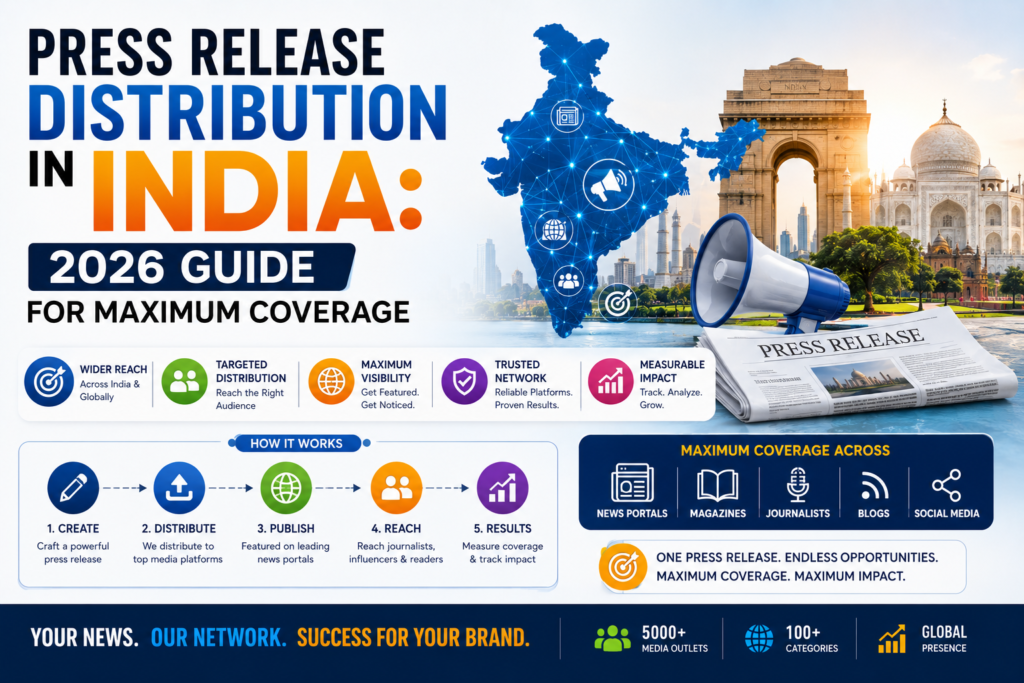
Press Release Distribution in India: The Ultimate Guide for Maximum Media Coverage in 2026
Everything You Need to Know About Professional PR Distribution in India
In India, brands typically send press releases to free websites and random email lists. Studies show that most journalists simply ignore these press releases.
The approach to press releases differs from brand to brand. What many overlook, however, is that professional Press Release Distribution is fundamentally different from simply sending emails to random lists or uploading to free websites. A professional PR agency sends your news to journalists who specifically cover your industry. These are the right people to cover your story — across newspapers, television channels, and relevant news websites.
Brands that use professional PR distribution get 3–5x more media coverage than those that don't invest in it.
A well-crafted press release, when distributed strategically, can establish a powerful, far-reaching presence for your brand across:
- Print media — Leading national newspapers and regional dailies.
- Digital media — News portals, industry websites, Google News.
- Television — News tickers, segments, and prime-time coverage.
- Radio — News bulletins and talk programmes.
- Social media — Syndicated stories get shared organically very rapidly in social media.
In this guide, I will walk you through everything you need to know about press release distribution in India in 2026 — from how professional PR distribution works and what it costs, to writing a press release that actually gets noticed. Whether you are a startup or an established brand, this guide is for you.
What Is Press Release Distribution?
In simple words, a press release is a formal news announcement written for journalists — and distribution is the process of getting it into the right hands: the editors, reporters, and correspondents who can publish, broadcast, or cover your story.
In India, most businesses do not understand the key difference between free distribution platforms and professional PR services:
| Free Press Release Sites | Professional Distribution | |
|---|---|---|
| Where it goes | A low-traffic website | Directly into journalist inboxes |
| Who sees it | Almost no one relevant | Beat-specific editors and reporters |
| Follow-up | None | 48–72 hour journalist follow-up |
| Wire access | No | PTI, ANI, IANS |
| SEO value | Very low | High-authority backlinks |
| Guaranteed coverage | Never | Available in premium packages |
Professional press release distribution goes far beyond mass emails and free platforms. It is a structured process built on key elements such as:
- Targeted email pitching to beat-specific journalists.
- News wire distribution through PTI, ANI, and IANS.
- Digital syndication across news aggregators.
- Direct follow-up with editors and reporters.
- Verified post-campaign placement reports.
The difference is simple — your story reaches people who genuinely want to tell it.
Why Professional Press Release Distribution Matters in 2026
1. Brand Visibility and Credibility
When your brand is featured in Times of India, NDTV, or The Hindu, it stops being just coverage — it becomes a signal of trust. This kind of visibility attracts investors, business partners, and customers far faster than any paid advertisement ever could.
Earned media is far more powerful than paid media — and the reason is straightforward. Readers treat PR coverage as an independent editorial endorsement, not a sales pitch. A third party is speaking for your brand, and that carries far more weight than anything your brand says about itself. That is precisely what builds genuine public trust — the kind no advertisement can buy.
2. SEO and Organic Traffic
Many media mentions from high-authority news domains — those with a Domain Authority of 60 or above — carry a backlink to your website. These backlinks signal authority to search engines, gradually lifting your search rankings. Unlike paid ads, this value continues to work for you long after the campaign ends:
- Backlinks from earned media are permanent.
- Media coverage drives branded search volume — people read about you, then Google you.
- Organic traffic from PR continues long after the campaign ends.
3. Coverage Across Print, TV, and Digital — Simultaneously
A professionally distributed press release reaches journalists across print, digital, television, and online news platforms simultaneously. A single well-executed PR campaign can generate:
- National newspaper features.
- Regional daily coverage.
- TV news ticker and segment appearances.
- Industry magazine placements.
- Digital news portal syndication.
4. Lead Generation and Shorter Sales Cycles
When buyers see your brand featured in a leading national publication like The Times of India, they seek out your website on their own — already convinced of your credibility. That kind of organic visibility consistently outperforms any paid display or full-page advertisement. Better still, leads from earned media are typically:
- More qualified.
- Closer to making a purchasing decision.
- Less price-sensitive.
When someone discovers your brand through The Times of India or NDTV, they do not need convincing. They arrive already trusting you. That pre-built credibility is what shortens sales cycles, reduces friction, and turns first conversations into closed deals — faster than any paid campaign ever could.
5. Crisis Management
When your brand is going through a challenging period, professional PR distribution becomes essential. It puts your official statement directly in front of leading, credible media outlets — keeping your narrative in your own hands. Your message reaches the most respected newsrooms first, giving you the opportunity to restore and reframe your brand reputation before anyone else shapes the story. More importantly, it leaves little room for competitors and critics to build negative narratives about your brand.
6. Cost-Effectiveness vs. Traditional Advertising
A full-page ad in a national newspaper like The Times of India or Hindustan Times costs anywhere between ₹5–15 lakh. At that price, you naturally expect maximum returns. Here is what most brands overlook: a professional press release distribution campaign delivers comparable media reach at a fraction of that cost — and unlike a paid ad, it earns significantly more reader trust because it reads as editorial content, not a sales pitch.
India's Media Landscape in 2026: What You're Working With
India's media market is one of the most complex and diverse in the world — and also one of the most rewarding, if you know how to navigate it strategically.
The Scale of Indian Media
- 9,500+ active journalists across print, digital, and broadcast.
- 500+ major print and digital publications.
- 20+ national TV news channels operating in multiple languages.
- Hundreds of regional dailies and local TV networks across every state.
National vs. Regional Distribution
National PR distribution targets top-tier outlets like The Times of India, Hindustan Times, Economic Times, and NDTV. These publications deliver brand visibility at a national scale, putting your story in front of English-speaking professionals — corporate decision-makers, high-profile investors, and industry leaders who shape markets.
Regional PR distribution targets state-level newspapers, city editions, and local television channels. It works particularly well for brands expanding into India's tier-2 and tier-3 markets, where audiences connect far more naturally with regional media than with national publications. In fact, regional coverage consistently drives higher engagement — precisely because the content feels closer to home.
The Language Dimension
India is not a single media market. News consumption varies sharply across regions, languages, and cultures — what resonates in Mumbai rarely lands the same way in Lucknow, and what works in English means nothing to a reader in Tamil or Telugu:
- English — national professional, investor, and corporate audiences.
- Hindi — the largest readership base; Dainik Jagran alone reaches 55 million+ readers.
- Tamil, Telugu, Marathi, Gujarati, Bengali — high-influence regional readerships where the next wave of Indian consumer growth is concentrated.
India has over 140 million readers who never pick up an English newspaper. They read Dainik Bhaskar, Amar Ujala, Eenadu, and Lokmat. They watch regional news channels in their own language, and they trust those sources far more than any national English outlet. A PR strategy that skips vernacular media does not just miss an audience — it misses the majority of the country. In India, regional language distribution is not an add-on. It is the strategy.
Industry-Specific Targeting
Generic press release blasts deliver poor results — because every journalist only covers stories within their beat, and an untargeted pitch lands in the wrong inbox every time. Effective PR distribution in India targets the right journalists by:
- Beat — Fintech, Real Estate, Healthcare, FMCG, Tech, Education.
- Language — English, Hindi, Tamil, Telugu, Marathi, Gujarati, Punjabi.
- Publication type — National dailies, metro supplements, trade publications, digital portals.
- Geography — National, regional, state-specific, city-specific.
How Professional Press Release Distribution Works: 5 Steps
Step 1 — Press Release Writing and Proofreading
Journalists ignore a press release the moment they spot a grammatical error or an overtly promotional tone. That is exactly why the best PR distribution services either write your press release from scratch or carefully edit your existing draft — ensuring it is clean, credible, and pitch-ready:
- Reads as journalism, not advertising.
- Has a clear, genuine news angle.
- Meets the structural standards editors expect.
- Is completely error-free before it leaves your hands.
Step 2 — Targeting the Right Journalists and Beats
Getting the best outcome from PR distribution comes down to one thing — targeting the right journalists. A tech product launch belongs with tech reporters. A healthcare announcement goes to medical correspondents. A real estate story lands with property journalists. The best PR distributors maintain detailed journalist databases, carefully organised by:
- Industry vertical and beat.
- Publication name and tier.
- Geographic location.
- Language and medium (print, digital, TV, radio).
The result is a press release that does not just go out — it lands exactly where it needs to, in front of journalists who are already primed to tell your story.
Step 3 — Distribution to Premium Networks
Your press release reaches journalists simultaneously via:
- Targeted email outreach to matched journalist contacts.
- News wire networks — PTI, ANI, and IANS — for immediate multi-portal syndication.
- Digital news aggregators — ensuring visibility across hundreds of platforms at once.
Wire distribution creates a powerful "momentum effect." When multiple media outlets publish your story simultaneously, trust and credibility build among consumers organically — before a single follow-up is even made.
Step 4 — Follow-Up with Editors and Reporters
Most DIY PR efforts fail for one simple reason — sending a press release once and hoping for the best is not a strategy. Real results come from a structured, repeatable process. That is exactly what professional PR distributors follow:
- Follow up 48–72 hours after initial distribution.
- Answer media inquiries directly.
- Provide additional information or executive access when journalists request it.
- Convert "opens" into actual published stories.
Most brands send their press releases and simply wait. That waiting is exactly where coverage dies. The follow-up step is what separates brands that get noticed from brands that get ignored — and done right, it can take a story from zero media coverage to 30+ verified placements.
Step 5 — Analytics and Coverage Report
After your press release is distributed, you receive a comprehensive performance report covering:
- Every publication that covered your release.
- Live URLs for all digital placements.
- Scanned print clippings from newspaper coverage.
- Estimated audience reach and circulation data.
- Backlinks generated from media mentions.
- Branded search traffic impact data.
This report is not just a summary — it is the clearest proof of what your PR investment actually delivered.
Riyo Advertising: India's Most Trusted PR Distribution Partner
In 2026, digital media leads in speed and targeting — but a headline in a respected national newspaper or a mention during prime time news still builds the kind of long-lasting trust that no digital campaign has managed to replicate.
Riyo Advertising is one of India's leading media buying agencies, operating with a 360-degree approach built over two decades of national service. With direct access to Mumbai's top national newsrooms and deeply rooted relationships across regional publications and local media networks throughout the country, Riyo ensures your message reaches the right audience — through exactly the right channel.
Why Brands Partner with Riyo for Press Release Distribution
Riyo has direct editorial relationships with India's leading national and regional publications — including The Times of India, Dainik Bhaskar, and Malayala Manorama — built and strengthened over two decades. It maintains equally strong ties with top news channels like India TV and Zee News. When Riyo pitches your story, it arrives with a level of credibility that cold-outreach platforms simply cannot match.
The Vernacular Advantage
India lives in its languages. A reader in Kochi trusts Malayalam. A consumer in Indore connects with Hindi. A buyer in Coimbatore engages with Tamil. Brands that speak only English are speaking to a fraction of the country — and leaving the rest to their competitors. Riyo changes that entirely. With the ability to translate and distribute your press release across 20+ regional languages, Riyo ensures your brand is not just nationally visible — it is locally trusted, in every market that matters, including the tier-2 and tier-3 cities where India's next generation of consumers is already spending.
Strategic Ad-PR Integration
Most PR distribution platforms send your story out once and stop there. Riyo does more. It puts your earned media and paid advertorials in the same publication, side by side. Your brand gets editorial trust on one page and strategic visibility on another. One publication. One reader. Two powerful impressions. That is not a mention — that is a brand presence.
End-to-End Execution
Riyo handles everything:
- Press release drafting to 2026 SEO standards.
- Beat-specific journalist targeting.
- Multi-channel wire distribution.
- Direct editorial follow-up.
- Verified media clipping reports.
Whether you are a startup announcing a Series A or an established brand launching a new product, your story deserves the right audience. Riyo makes sure it gets there — straight to the newsrooms that matter most in India.
India PR Distribution: The All-in-One PR Platform
India PR Distribution brings journalist outreach, professional distribution, and brand visibility together in one place. Whether you are a first-time founder or running an established enterprise, it gives you everything you need to put your story in front of the right people — without the complexity.
What Makes India PR Distribution Different
- Expert proofreading — every release is reviewed before it goes out, eliminating the errors that cause journalists to delete releases immediately.
- Targeted, not mass-blast — distribution is matched to journalist beats, not sent to irrelevant contacts.
- Guaranteed placements — premium packages offer confirmed coverage, not just distribution attempts.
- Packages starting at ₹4,999 — accessible for startups and SMEs.
- Top-tier media coverage — includes TOI, NDTV, PTI, ANI, and 500+ publications.
- Journalist access for brands — connects brands with the reporters actively covering their industry.
Types of Press Release Distribution Packages in India
Basic Digital Distribution — ₹3,999 to ₹9,999
Built for brands that need focused, targeted outreach over broad national coverage. It places your story in digital publications and industry-specific media, making it the right fit for niche, local, and regional campaigns where precision matters more than scale.
Premium Distribution with Guaranteed Placements — ₹12,000 to ₹35,000
Some announcements simply cannot afford uncertainty. A funding round, a product launch, a leadership change — these are moments that define how the market sees your brand for years to come. This tier removes all the guesswork. You get confirmed coverage in specific, named publications — so before the campaign even begins, you already know exactly where your story will land.
Industry-Targeted Packages — ₹10,000 to ₹25,000
A healthcare announcement means nothing to a finance journalist. A fintech story gets ignored in a food and beverage newsroom. This package eliminates that mismatch entirely. Every journalist who receives your press release covers your sector — nothing more, nothing less. The result is sharper relevance, stronger response rates, and coverage that actually reaches the audience your brand needs.
Full PR Campaign — Writing, Distribution and Follow-Up — ₹35,000 to ₹2,00,000
Most brands have a story worth telling. Not all of them have a team to tell it. This package covers everything — from the first blank page to the final verified coverage report. Your press release gets written by professionals who understand what journalists actually want to read. It gets distributed to the right people across the right channels. It gets followed up personally until the coverage lands. You stay focused on running your business. Riyo handles everything else.
Print + Electronic + Digital Combo — Custom Pricing
Some stories are bigger than a single channel. This package puts your press release everywhere that matters — national newspapers, TV news channels, radio networks, and digital publications — all at once. One story. One campaign. Every major platform in India is covered simultaneously. For brands that need maximum visibility across the entire media landscape, this is the package that leaves nothing on the table.
How to Write a Press Release That Gets Picked Up
Structure matters just as much as the words inside it. A poorly-structured press release gets ignored before the journalist even reaches the second paragraph — no matter how good the story is. Here is exactly what they expect to see:
Headline
- Under 100 characters.
- Specific, not vague.
- Most important information first.
- No marketing language — write it like a news headline.
Dateline
- Format: "MUMBAI, May 14, 2026 —".
- Establishes location and timing immediately.
Lead Paragraph
- 30–40 words maximum.
- Answers: Who, What, When, Where, Why.
- A journalist who reads only this paragraph must understand the full story.
Body Paragraphs
- Background, supporting details, and context — in order of importance.
- Use real statistics and specific data.
- Vague language reduces media interest immediately.
Executive Quote
- One quote from a named executive with their full title.
- Must provide insight or context — not generic self-promotion.
- Example of a bad quote: "We are excited to announce this launch."
- Example of a good quote: "This product addresses a gap we identified in 47,000 patient records across three states."
Boilerplate
- 2–3 sentences about the company.
- What it does, where it operates, official website URL.
- Consistent across all press releases.
Contact Information
- Name, designation, phone number, and email of your media contact.
- Journalists need this to follow up, interview, or request additional information.
Common Mistakes That Kill Press Release Campaigns
Free distribution sites do more damage than good. They publish without editorial standards, which is exactly why journalists discount them — and coverage on these platforms carries almost no SEO value either, since their low domain authority means search engines largely ignore their backlinks.
Sounding like an advertisement is one of the biggest mistakes a press release can make. Words like "industry-leading," "revolutionary," and "game-changing" signal to journalists that there is no real story — and they stop reading the moment they spot one. A press release that works is built on a genuine news angle, clear facts, and quotes that add real voice to the story. The moment it reads like an ad, it stops being news.
Sending to the wrong journalists: A fintech story means nothing to a sports journalist — and sending it to one does not just waste an opportunity. It does real damage. Journalists flag irrelevant senders. Inboxes start filtering them out. Response rates drop. And by the time your next campaign goes out, your sender reputation has already taken a hit you never saw coming. Relevance is not optional in PR outreach — it is the foundation everything else is built on.
No follow-up: Journalists receive hundreds of emails every day. A single press release sent once has a real chance of getting buried. A professional follow-up at 48 to 72 hours after distribution changes that — it is often the one nudge that turns a sent story into a published one.
Burying the news angle: If your press release does not deliver the key information within the first two sentences, most journalists stop reading. Lead with what matters most — because in a crowded inbox, there is no second chance to make a first impression.
Real Results: What Professional PR Distribution Delivers
Case Study 1 — Mumbai Fintech Startup, Series A Announcement
In Mumbai, a fintech startup distributed its funding announcement through professional PR distribution and landed coverage across 47 publications — including Economic Times and VCCircle — within 72 hours. And that was just the beginning. The same campaign generated 23 high-authority backlinks and a 340% spike in branded search traffic, all within the same week.
Case Study 2 — Healthcare Brand, New Product Launch
In Mumbai, a fintech startup distributed its funding announcement through professional PR distribution and landed coverage across 47 publications — including Economic Times and VCCircle — within 72 hours. And that was just the beginning. The same campaign generated 23 high-authority backlinks and a 340% spike in branded search traffic, all within the same week.
Case Study 3 — Edtech Company, Regional Expansion
An edtech company targeting regional expansion ran its PR campaign across Tamil, Telugu, and Marathi — and secured coverage in 12 publications across three new state markets. The results did not stop there. By speaking directly to regional audiences in their own language, the campaign built genuine local trust. Within two weeks, that trust translated into 2,400 new app installs from the exact regions they were targeting.
Frequently Asked Questions About Press Release Distribution in India
Press release distribution gets your news into the right hands — directly reaching journalists, editors, and media outlets through targeted outreach, established wire networks like PTI, ANI, and IANS, and digital syndication. Beyond that, professional services follow up with media contacts personally and deliver a verified placement report so you know exactly where your story landed.
Costs usually start from ₹4,999 for basic digital distribution and can go beyond ₹2,00,000+ for fully managed campaigns with guaranteed placements. Most standard campaigns that cover national and regional media typically fall between ₹12,000 and ₹35,000.
Free sites usually publish your release on low-authority pages that journalists rarely notice. Professional PR distribution sends your release directly to relevant journalists, shares it through news wire networks, and follows up to help generate real media coverage with measurable SEO value.
Most professional campaigns start generating media coverage within 48–72 hours. Results usually grow over the next 7–14 days as more journalists and publications pick up the story. Wire placements often appear much faster, sometimes almost instantly.
Yes. When media outlets cover your story, they often link back to your website. Backlinks from high-authority news domains (DA 60+) can improve your search rankings over time. Media coverage also increases branded searches, as people who read about your brand often search for it later. This can keep bringing organic traffic even after the campaign ends.
Yes. Packages start from ₹4,999. Even a single quality media placement can improve brand credibility, bring inbound enquiries, and support better SEO performance. In many cases, the long-term value goes far beyond the original campaign cost.
Strong topics for a press release include product launches, funding announcements, leadership changes, strategic partnerships, award wins, research reports, market expansions, and major business milestones. Journalists usually look for something new or important. If there is no clear development or update, the story is less likely to attract media attention.
They serve different purposes, and they work best when used together. Earned media (PR) helps people trust your brand more. It also builds long-term SEO backlinks and keeps strengthening your online presence over time. Paid advertising gives you better control over your message and helps you reach people quickly at the right moment. That's why many successful Indian brands in 2026 use PR to build credibility and advertising to grow reach and visibility faster.