
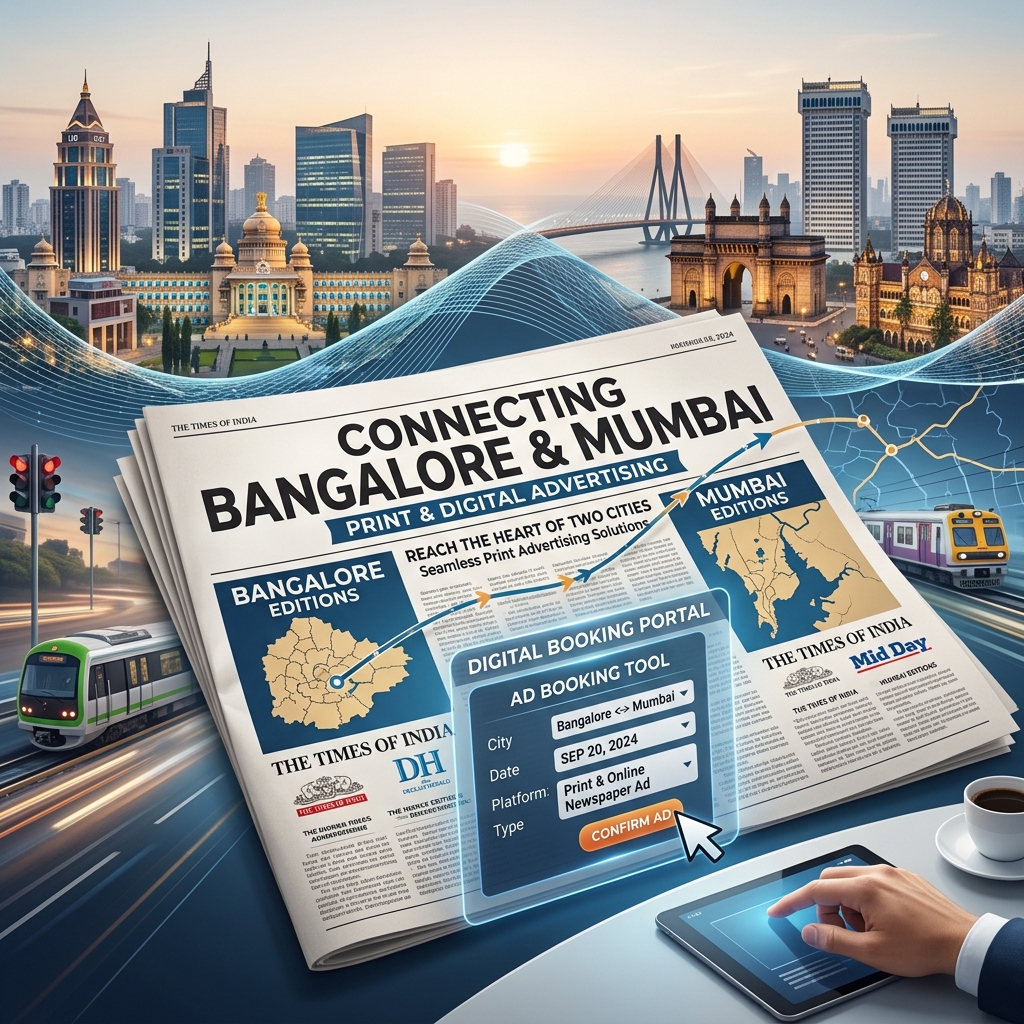
It's supposed to be an era passed when printing was dead. A few people must have left out the legal departments, property developers and brand managers who are spending crores every month on newspaper advertising in Bangalore and Mumbai.
As of 2026, India's two commercial giants -- the Silicon Valley of the South and the country's financial capital -- still rely heavily on print media to publish public notices as mandated by the law and for high-profile brand campaigns. In Bangalore and Mumbai, where the advertising industry is dynamic, newspaper ads aren't simply surviving, they are changing. QR codes, augmented reality features and advanced online booking tools are transforming the way ads are conceived and displayed.
If you're a business owner, a lawyer, or just finally having to issue a legal notice for your property, we got you covered for the latest 2026 ad rates, the ideal newspapers for your objective, and much more. You can consult a leading newspaper advertising agency Mumbai or an expert advertising agency in Bangalore for professional guidance.
Table of Contents
Why Print Still Dominates in Bangalore and Mumbai
The rates, as well as the how, come after the why of these two markets being particularly difficult to connect to the "print is dead" narrative.
- Trust is transactional in India. There is credibility that a newspaper ad can give which Google ads can easily not do for high stakes decisions, especially if it is a known masthead such as Times of India or Deccan Herald. Still newspapers are the first place home buyers and job seekers will turn when they need to learn, and also when court readers need to learn.
- Legal requirements enforce relevance. Indian legislation requires newspapers to publish a variety of notices such as name changes, property disputes, lost documents, insolvency proceedings and public tenders. This isn't optional. Courts and government departments need to be furnished with evidence of the publication, usually in both an English language daily and a publication in a local language. Newsprint will continue to be essential as long as there are these legal requirements.
- Hyper-local targeting still beats digital in key sectors. It is a fact that even a half page in the right newspaper is better for one or two target audiences than a lot of digital advertising.Any property developer who caters to buyers in South Bangalore's Jayanagar or any financial firm who reaches HNI's in South Bombay would tell you this.
- Integration is the additional part of this story in the year 2026. The newspapers are now putting QR codes in an ad and linking it to video, booking portals and augmented reality experiences, which is a first for newspapers and the printed page.
The Bangalore Market: Newspapers, Audiences, and 2026 Ad Rates
Unlike Mumbai, the readership in Bangalore is highly diversified and can be attributed to the diversity of the Bangalore populace comprising tech professionals, traditional Kannada speakers, students and migrant workers from all over India.
Top Newspapers for Advertising in Bangalore
- Times of India (Bangalore Edition): English will continue to be the language of choice. It is a popular read among the IT corridors at Whitefield, Electronic City and Koramangala and is the preference for recruiting and hosting tech events and premium classifieds.
- Deccan Herald: The preferred English-language paper for legal notices in Bangalore. It is very well known among the city's professional and government associated readership as well as being cited by courts by name for publication requirements.
- Vijay Karnataka: The main Kannada daily and is crucial for any campaign aiming to reach at least the traditional South Bangalore audience or for legal notices which have to be made in the regional language.
- Prajavani: Another leading Kannada daily, has been able to provide decent reach in the city of Bangalore as well as in Karnataka's tier-2 towns, which is handy for state-wide property/promo or business announcements.
Targeting the Right Bangalore Audience
The IT corridor (Whitefield, Bellandur, Sarjapur Road, Electronic City) is skewed towards younger, higher income and English-reading. TOI, The Hindu and digital tie-ups that are associated with LinkedIn are the most effective here.
The older and more local audience of the traditional South Bangalore (Jayanagar, Basavanagudi, JP Nagar) regions are more avid readers of Kannada language. For them, Vijay Karnataka and Prajavani should be unmissable.
2026 Ad Rate Benchmarks — Bangalore
| Ad Type | Approximate Rate (2026) |
|---|---|
| Classified Text (TOI Bangalore) | ₹500–₹900 per line |
| Classified Display — per sq. cm (Deccan Herald) | ₹350–₹600 |
| Display Ad — Page 3 (TOI Bangalore) | ₹1,200–₹2,000 per sq. cm |
| Front Page Strip / Jacket (TOI) | ₹5–₹15 lakh per insertion |
| Legal Notice — English daily | ₹8,000–₹30,000 (size-dependent) |
| Sunday Premium Surcharge | 20–40% over weekday rates |
Note: Rates vary by edition, season, and negotiated volumes. Request a rate card directly from the publication or use an online booking portal for real-time pricing.
The Mumbai Market: Reaching India's Financial Capital
Mumbai's media landscape is more concentrated than Bangalore's — a handful of dominant titles command enormous combined reach across extremely diverse socioeconomic groups.
Top Newspapers for Advertising in Mumbai
- Times of India (Mumbai Edition): which historically bundled Mumbai Mirror, remains the city's highest-circulation English daily. It is the standard choice for recruitment, property, education, and brand display campaigns.
- Hindustan Times: offers strong readership among Mumbai's English-educated middle and upper-middle class, with competitive rates compared to TOI.
- Mid-Day: fills the commuter niche uniquely — distributed heavily at railway stations across Mumbai's local train network; it reaches the city's massive working population during their daily commute. For affordable, high-frequency classifieds, it's underrated.
- Lokmat: is Maharashtra's largest Marathi daily and the paper of record for reaching Mumbai's Marathi-speaking population. For public notices with legal validity in Maharashtra, pairing an English daily with Lokmat or Maharashtra Times is standard practice.
- The Economic Times and Mint: serve the financial and business community — essential for B2B advertising, IPO announcements, corporate notices, and financial product promotions targeting HNI and institutional audiences.
Audience Targeting in Mumbai
The commuter audience (local train network) is best reached through Mid-Day, with ad placements timed to morning and evening peak-hour distribution.
South Bombay's HNI demographic — concentrated in Nariman Point, Malabar Hill, Colaba, and Cuffe Parade — is best reached through TOI front section, Hindustan Times, Economic Times, and Mint.
The suburban mass market (Thane, Navi Mumbai, Virar, Borivali belt) responds well to Lokmat and Maharashtra Times for regional-language campaigns, and to TOI/HT for English-language ones.
2026 Ad Rate Benchmarks — Mumbai
| Ad Type | Approximate Rate (2026) |
|---|---|
| Classified Text (TOI Mumbai) | ₹700–₹1,200 per line |
| Classified Display — per sq. cm (Hindustan Times) | ₹500–₹900 |
| Display Ad — Page 3 (TOI Mumbai) | ₹1,800–₹3,200 per sq. cm |
| Front Page Strip (TOI Mumbai) | ₹15–₹40 lakh per insertion |
| Legal Notice — English daily (Mumbai) | ₹15,000–₹50,000 (size-dependent) |
| Economic Times / Mint — Financial Notice | ₹20,000–₹80,000 |
"Page 3" in Mumbai carries significantly higher premiums than in Bangalore — the city's celebrity and society culture drives premium demand for this placement, especially on Thursdays and Fridays.
Legal Notices & Public Announcements: What You Must Know
It is the most read part of the text after encountering difficulties. Read it before posting your ad.
Why Newspapers Are Legally Binding
Multiple laws in India such as the Registration Act, the Indian Succession Act, the Insolvency and Bankruptcy Code and several state laws will mandate newspaper advertisements. The principle of “constructive notice” applies: if the item is published in a newspaper with adequate circulation, then the public is presumed to be notified of the item, even if no one reads it.
The published clipping (also known as a voucher copy) is a required document for courts, government agencies and registrars. In most legal situations, a notice posted online, sent via WhatsApp or even a government website notice are not an adequate substitute for newspaper publication.
Most Common Legal Notice Categories
- Name Change — Must be published in official gazette and local newspaper. The newspaper should generally be bilingual – English and the state language – in Karnataka and Maharashtra.For Karnataka and Maharashtra, English must be with the local language.
- Property Disputes and Transactions — Lost title deeds, disputed boundaries, and certain property sale announcements require public notice.
- Lost & Found Documents — such as passports, academic certificates, vehicle documents, publishing a loss notice in a newspaper will help to ensure that the document is not used inappropriately and is a requirement for issuing authorities.
- Public Tenders — Public and PSU procurement requirements advertised in newspapers pursuant to transparency requirements.
- Insolvency / Bankruptcy — According to the IBC, a public notice has to be published in the specified publications.
The Dual-Publication Rule
This catches many first-timers. Most legal notice requirements in India specify publication in both an English-language daily and a regional-language daily in the state where the notice is relevant.
For Bangalore: English (TOI or Deccan Herald) + Kannada (Vijay Karnataka or Prajavani). For Mumbai: English (TOI or Hindustan Times) + Marathi (Lokmat or Maharashtra Times).
Skipping the regional-language publication can invalidate the notice's legal standing. Always confirm the specific requirement with your lawyer before booking.
Understanding Newspaper Ad Rates: The 2026 Pricing Matrix
In India there are three different pricing models in newspaper advertising. If you know which one you are applying, it saves time, money and will help to avoid sizing errors.
1. Classified Text Ads — Pay Per Word or Line
The simplest and most affordable format. Text only, no images, no borders. Priced per word or per line, depending on the publication.
Best for: Job postings, matrimonial listings, small announcements, lost-and-found notices.
Cost tip: Every extra word costs money. Draft copy tightly. "Lost passport near Andheri station, contact 9XXXXXXXX0" is better than a paragraph.
2. Classified Display (CD) Ads — Pay Per Square Centimeter
Classified Display ads are priced by the physical space they occupy — width × height in centimeters. They can include logos, borders, images, and formatted text, making them significantly more eye-catching than plain classified text.
To calculate your cost: Width (cm) × Height (cm) = Total sq. cm → multiply by the publication's base rate for that page/section.
Example: A 10cm × 12cm CD ad in a section priced at ₹500/sq. cm costs ₹60,000.
Best for: Real estate listings, business announcements, recruitment with branding, legal notices requiring visual impact.
3. Display Ads — The Premium Choice
Full editorial-style display ads placed in specific sections of the newspaper. These are what you see from banks, car brands, and real estate developers. Priced per sq. cm with significant premiums for specific positions.
Premium positions to know:
- Front Page / Jacket: Maximum visibility, commands highest rates. Typically booked 7–10 days in advance.
- Skybus: A horizontal strip running across the bottom of the front page — high-impact, slightly more affordable than a full front-page ad.
- Jacketad: The newspaper wrapped in an advertiser's branded "jacket" — premium brand visibility for launches and major announcements.
- Page 3: Society/lifestyle section — premium in Mumbai due to the celebrity readership culture; more moderate in Bangalore.
- Sunday premium: Sunday editions carry 20–40% rate surcharges, especially for matrimonial, property, and lifestyle sections — justified by measurably higher circulation and readership on weekends.
How Online Booking Portals Have Changed Newspaper Advertising
Five years ago, booking a newspaper ad meant calling an agency, faxing a draft, negotiating rates over phone calls, and hoping the ad ran correctly. In 2026, the process has been compressed to minutes.
What Online Portals Offer
The majority of the leading newspaper companies have their booking portals (TOI's Ads2Book, for instance) and a few third-party aggregators make it possible to compare rates side by side at different newspapers.
- Live rate cards — Real-time pricing with section and position selection
- Draft preview — See exactly how your classified or display ad will look before payment
- Edition selection — Choose Bangalore, Mumbai, or both from one dashboard
- Booking history and voucher copies — Downloadable proof of publication for legal purposes
Booking a Newspaper Ad: Step-by-Step
- Choose your portal (publication's own or a third-party aggregator)
- Select city/edition → publication → ad category → section
- Input your copy or upload your artwork
- Preview the ad as it will appear in print
- Select your publication date(s)
- Pay online (UPI, net banking, credit card)
- Receive booking confirmation and, post-publication, your e-paper proof
The entire process typically takes under 10 minutes for a standard classified.
Booking Deadlines in 2026:
Classified Text / CD Ads: 1–2 days before publication (some platforms accept same-day for select publications).
Display Ads: 3–5 days minimum.
Premium Positions (Front Page, Jacket): 7–10 days — these sell out, especially around festive seasons.
The "last-minute booking" culture is real — particularly for classifieds — but don't rely on it for anything premium or time-sensitive.
Case Study: Running a Property Public Notice Across Bangalore and Mumbai
To make the pricing matrix concrete, here's a real-world example of a dual-city property notice campaign.
Scenario: A property developer needs to publish a public notice regarding a disputed title deed that affects buyers in both cities. Legal counsel requires publication in English and regional-language dailies in both Karnataka and Maharashtra.
Required publications: Deccan Herald (Bangalore, English) + Vijay Karnataka (Bangalore, Kannada) + Times of India (Mumbai, English) + Lokmat (Mumbai, Marathi)
Ad size: 20cm × 10cm Classified Display in each publication
| Publication | Rate per sq. cm | Total (200 sq. cm) |
|---|---|---|
| Deccan Herald | ₹400 | ₹80,000 |
| Vijay Karnataka | ₹200 | ₹40,000 |
| Times of India Mumbai | ₹700 | ₹1,40,000 |
| Lokmat Mumbai | ₹250 | ₹50,000 |
| Total | - | ₹3,10,000 |
With a combo package discount (30–50%): Final cost could come down to ₹1,55,000–₹2,17,000.
This illustrates why combo packages matter — and why working with an aggregator or direct account manager at the publication group pays off for multi-city campaigns.
FAQ: Newspaper Advertising in Bangalore and Mumbai
The cost of a legal notice in a local Mumbai daily begins at ₹3,000. Time of India, Hindustan Times and other prominent English newspapers sell for ₹15000 to ₹50000. Regulated notices may be more expensive for financial publications, such as The Economic Times.
For legal requirements, it is best to use Deccan Herald or Times of India for English. This is to be coupled with Vijay Karnataka or Prajavani to comply with the Kannada regional-language requirement. These must both be included in the notice for it to be complete.
Yes. You can check out any city and edition and publication in India from a single dashboard with the online booking portal. Book and pay for an ad in a Mumbai newspaper from Bangalore without having to call an agent — anywhere!
Yes. They tend to be more expensive than weekday editions, especially for matrimonials, property and lifestyle sections, which attract 20-40% higher circulation and readership. If Sunday time is critical for your category, then plan the budget accordingly.
The majority of the publications in Bangalore and Mumbai require a notice copy that is prepared by a lawyer and a copy of the advertiser's ID proof. Additional legal documents may be required for some publications. Please check with the publication for specific requirements prior to booking.
Multiply the ad's width by its height to get total square centimeters (e.g., 10cm × 12cm = 120 sq. cm). Then multiply by the publication's base rate for that section. A 120 sq. cm ad at ₹600/sq. cm costs ₹72,000 before any surcharges.
Most big publication groups will be able to provide combo packages for multi city bookings which will help you save up to 30–50% from booking each city separately. Before committing, have the account manager or look at the portal's "combo package" section.
For regular classifieds, you can expect to sign up in 1–2 days. Book 7-10 days ahead for top-tier display spots, such as on the front page or as jackets — particularly during holiday periods when these can fill up fast.
The top choice newspapers for Marathi reading in the Mumbai Metropolitan area are Lokmat and Maharashtra Times. Either of these is the standard choice for legal notices which need to be published in a regional language in Maharashtra.
Once published, you can get an e-paper proof from the portal of the publication immediately. To get physical copies (which courts and registrars sometimes demand) call your booking agent or the publisher's circulation department well ahead of time to save copies.
Conclusion: Future-Proofing Your Print Strategy
Newspaper advertising in 2026 is not a thing of the past or one which has not changed. It's at a fascinating crossroads — required (in many scenarios) and trusted (in high value scenarios) and now being dovetailed into digital tools that are expanding its scope.
The basics of these rules are still the same: match the newspaper to the audience, be aware of legalities before booking, take advantage of combo and book high paying slots early. Print advertising used to be such a task as having to deal with an agency back-and-forth email for days and days — but online portals have eliminated that complexity, requiring only a few minutes on a phone.
Print continues to change. The books that make it to the next 10 years will be the ones that can span the power of print and the targeting and measuring capacity of digital. For advertisers, that's a positive development — it's a channel that's more accountable, has better tools and still earns reader trust which few digital channels can rival.