
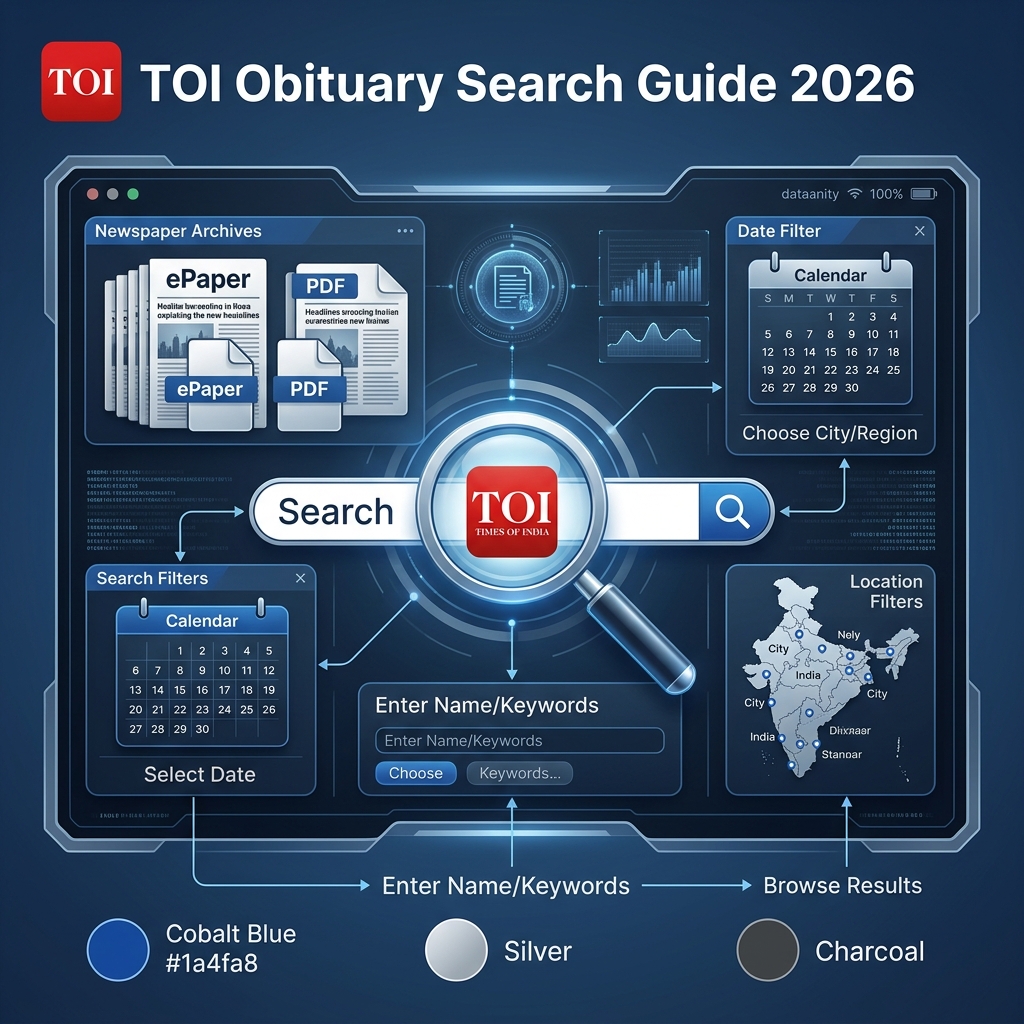
You have a name. You know the general timeframe of the date. The real notice is what you need now and quickly.
Perhaps a family member has phoned and informed you that the Chautha ceremony is happening tomorrow, and you want to confirm the time and address. Perhaps your bank requires additional documentation that a family member has passed away. Perhaps you are looking for a notice published years ago for genealogical research. Regardless, it's not always easy to find a particular **Times of India obituary today** or in the past, especially given the numerous regional editions and decades of archives.
This guide cuts through the confusion. Here you'll find 5 different ways to do it in order of speed and ease, and all the information you need to know about sourcing an official copy for legal use.
Method 1: Search the Times Obituary Digital Portal
The Times Group has a special tributes and death announcement online site, timesobituary.com. This portal allows you to do a name search as opposed to browsing page-by-page.
- Go to timesobituary.com: Access the official portal.
- Search by Name: Type in the complete legal name. Use variations (e.g., "Suresh" and "Suresh Kumar") if needed.
- Apply Filters: Filter by city (Mumbai, Delhi, Bengaluru) and date range. This is crucial if the name is common.
Best for: Notices issued within the past year or two.
Method 2: Check the TOI ePaper
For insurance claims or property transactions, the ePaper is the most accurate as it shows the actual print layout.
- Visit epaper.timesgroup.com: Select the primary city edition (e.g., Times of India – Mumbai).
- Choose the Date: Most notices are published 1 to 3 days after the death.
- Go to Classifieds: Usually found on the last few pages. Check the index on page one.
- Save as PDF: Use the "Clip" tool to save a high-resolution version.
Method 3: Use Google Search Operators
Google often indexes pages faster than manual site searches. Use this specific operator:
This filters results to only the TOI domain and matches the name exactly. If no results appear, try removing middle names or using initials.
Method 4: Search Archived Obituaries (Older Than One Year)
TOI has one of the most complete archives in Asia, dating back to 1838.
- Digital Archives: Records before the 2000s are accessible via Times Content (timescontent.timesgroup.com) with a paid subscription.
- Physical Archives: Major state libraries (e.g., National Library of India, Kolkata) house physical microfilm reels for authoritative research.
- ePaper Archive: Usually searchable back to 2008 for active digital subscribers.
Method 5: Contact the TOI Classified Ad Desk Directly
When digital attempts fail, call the source. The classified desk keeps records of all original submissions, including the city and date of publication. They can also provide guidance on obtaining certified official copies.
Information Needed Before You Start
| Detail | Why it's Important |
|---|---|
| Complete Name | Look for misspellings or common shortened versions (e.g., "Suresh" vs "Sureshchandra"). |
| Date of Passing | Notices are usually published 1-3 days after death. Anniversary notices on the same date annually. |
| City or Edition | TOI has 30+ city editions. Regional notices won't appear in national editions. |
Why You Might Need an Official Copy
A newspaper death notice is often required for several legal and administrative reasons in India:
Insurance & Banking
Many life insurance companies and banks accept newspaper notices to verify the death certificate for account closures or survivor claims.
Legal & Estates
Lawyers may need to document the timeframe of death and public notification during property transfers or succession disputes.
Need Help Finding or Booking an Ad?
Authorized TOI Classified Partners for 22+ Years.
Frequently Asked Questions
The quickest way is to go to timesobituary.com and type in the name. Results can be filtered by city and date range. Alternatively, use Google with the site:timesofindia.indiatimes.com operator.
The ePaper archive usually includes editions from 2008 onwards. The Times Content archive (timescontent.timesgroup.com) features digitized notices dating back to 1838 on a paid basis.
Yes. Download the entire newspaper page from the ePaper (including headers). Some legal authorities may require reprints from the Times Content archive for older notices.
Some notices (older ones or vernacular supplements) may not be fully indexed. In this case, contact the TOI classified desk or visit a public library with microfilm collections.
Yes, but a notice in one edition (e.g., Mumbai) won't appear in another (e.g., Delhi) unless the family subscribed to a multi-city package. Always check the city-specific edition.
These are printed on the anniversary date. Search the ePaper for that specific date and city, or use the date filters on timesobituary.com.
The ePaper is often free for the last 30 days. Timesobituary.com is also free to search. Records older than 2008 usually require a trip to a library or a paid archive subscription.
Yes, by browsing the ePaper classifieds day-by-day for a one-week period around the suspected date. Focus on the 1-3 days immediately following the date of passing.
Obituaries are published by family to inform of a death/funeral. Condolence ads are published by third parties (companies, associates) to extend sympathies. Both appear in the classifieds.
It is accepted as corroborative evidence, not primary proof. The primary proof remains the Municipal Death Certificate. Always verify with your legal counsel.
Conclusion
Whether you're searching for a notice from this morning or fifteen years ago, the right method depends on your precision and purpose. For quick searches, use the portal or Google. For legal documentation, the ePaper full-page download remains the gold standard.
The hardest part of this process is rarely the technology — it's knowing where to start. Now you do.