
What is Hoarding Advertising? Types, Benefits, Costs and Examples (2026 Guide)
What is hoarding advertising? Learn about types of hoarding ads, costs in India, advantages, real brand examples, and how hoardings rank in outdoor advertising strategy in 2026.
What is Hoarding Advertising?
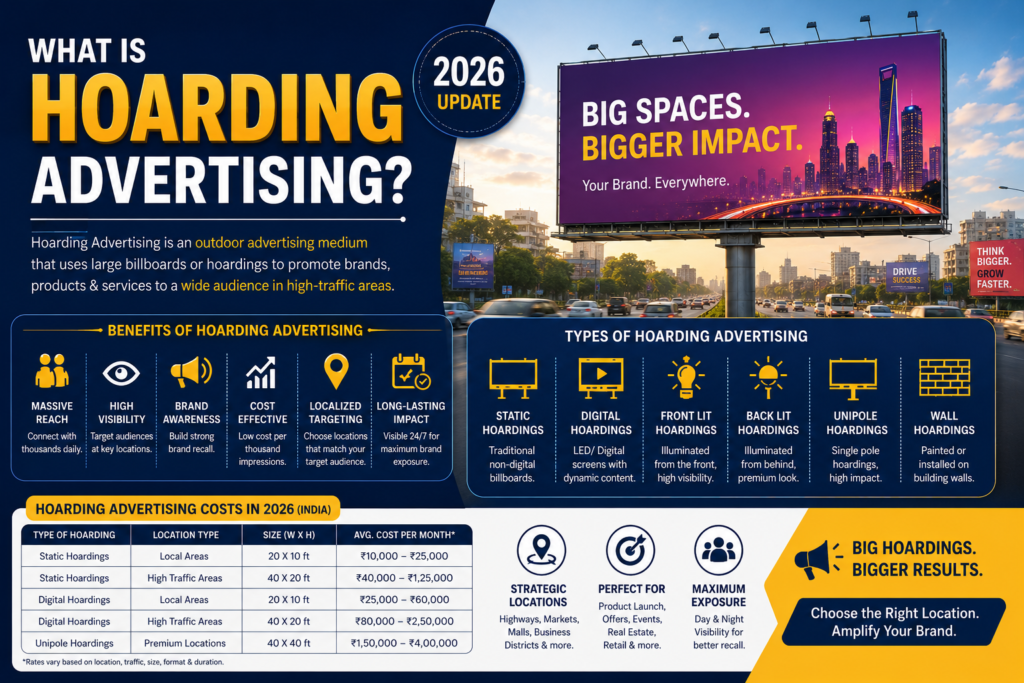
Hoarding advertising is a type of outdoor advertising in which brands put up their advertising message on elevated structures, construction barriers, building walls or billboards in high-traffic areas of the public. Also known as billboard advertising, out-of-home (OOH) advertising is intended to reach a large, targeted population of commuters, pedestrians and motorists with a clear, powerful message.
In India, the UK and Southeast Asia, the word "hoarding" is commonly used for what Americans refer to as a "billboard." Hoarding advertising is one of the most proven and trusted ways of communicating a brand and is utilized by brands ranging from small local businesses to large national FMCG companies in India.
Hoarding ads are typically placed along:
- National and state highways
- Busy urban intersections and flyovers
- Near malls, markets, and commercial hubs
- Metro stations, airports, and railway areas
- Construction site barriers in city centres
The basis of hoarding advertising is repetition. A hoarding is a graffiti-resistant, invisible to thousands of viewers passing by each day, digital ad.
What is Hoarding Advertising Used For?
Hoarding advertising is used by brands and organisations for various marketing purposes:
- Brand Building: Long-term hoardings in premium locations build brand recall and establish credibility. Trust is created when a name is seen in real-life space, which is not always the case with online ads.
- Product Launches: When a new product, service, or film comes into the market, hoarding can quickly get the word out to the masses.
- Event Promotion: Concerts, sporting events, political campaigns and religious events are all good examples of event promotions where the announcement to the local population is time sensitive.
- Real Estate Marketing: Real estate builders and developers have their hoardings placed around project sites and arterial roads to lure buyers and investors.
- Retail & FMCG: High footfall areas at malls & markets complement TV or digital campaigns.
- Government and Public Awareness: Health campaigns, civic schemes, election messaging, and public safety announcements widely use hoarding formats.
A marketing perspective of a hoarding's role is to get noticed in 3-5 seconds, communicate one message and create a memorable visual impact.
Types of Hoarding Advertising
Marketers can use the knowledge of the types of hoarding advertising to select the most appropriate format to align their advertising objective, place and budget.
1. Traditional Static Billboards
Traditional billboards are advertising panels printed onto steel structures and mounted on the roadside and highways, and are located in urban areas. They are the most popular and prevalent hoarding format used in India. This creative is used to print on vinyl or flex and is not modified through the campaign and usually stays the same for one to three months.
Best for: Long-term brand visibility, real estate, FMCG, retail, and political campaigns.
2. Digital Billboards (DOOH)
Digital out-of-home (DOOH) billboards are the displays of dynamic information such as videos, animation and rotating creatives from a number of advertisers. They enable real-time content update and day-parting (ads shown at different times), as well as messaging when triggered by weather or an event.
Best for: Premium brand campaigns, product launches, retail promotions, and brands seeking flexibility with creative rotation.
3. Mobile Billboards
Mobile billboards are advertisements on trucks, vans or buses that move along set routes in specific locations. The format lets the advertiser go directly to the message recipient where they like instead of having to pass a set point.
Best for: Event marketing, hyperlocal campaigns, political outreach, and product activations.
4. Wallscapes and Building Wraps
Wallscapes are large scale outdoor advertisements that are painted or rolled around the outside walls of buildings, usually in the thick City centre. They create a dramatic visual impact and are impossible to miss. Because wallscapes are so large, it is regarded a premium format, and is linked to category-leading brands.
Best for: Brand dominance campaigns, luxury products, entertainment releases, and landmark locations.
5. Construction Hoardings
Construction hoardings are temporary structures which are put up around a construction or renovation site and used for advertising purposes. Brands invest in big format creative wrapping of these barriers instead of leaving them exposed and visible to the public. Construction hoardings are a regular feature in fast growing cities in India and Tier-2 markets.
Best for: Real estate developers, hyperlocal businesses, and brands targeting specific neighbourhoods during construction periods.
6. Backlit and Frontlit Hoardings
Hoardings that are backlit illuminate from the inside, and glow uniformly in low-light settings. The external flood lights are used to light up the face of an ad from the outside, and are known as frontlit hoardings. Either format provides 24-hour visibility and thus is very effective in areas where traffic is high at night.
Best for: Any campaign where round-the-clock visibility is a priority, particularly in entertainment zones, airports, and highway stretches.
7. Unipole Hoardings
Unipole hoardings are big billboard panels installed on a pole with just one piece of structure, at a notable elevation for greater visibility. They are frequently found on national highways and ring roads and at important fly over points. This high placement ensures that the ad stands out above traffic, trees and nearby buildings.
Best for: Highway advertising, automotive brands, FMCG, and telecom campaigns targeting commuters.
8. Gantry Hoardings
Gantry hoardings are the hoarding usually put across roads or highways, between two structural supports, akin to gantries used for road signs. One of the most impactful formats they can offer is being right in the view of any vehicles driving under them. Commonly, gantry hoardings are found at toll plazas and at the big junction of the highways.
Best for: Automotive, fuel, travel, highway retail, and any brand targeting vehicular traffic.
How Hoarding Advertising Works in Modern Marketing
Hoarding advertising has evolved well beyond paste-and-wait. Modern outdoor advertising campaigns are planned and executed with the same data discipline applied to digital media.
Strategic Location Planning
Effective hoarding campaigns are built on location intelligence — not instinct. Media planners evaluate:
- Daily traffic count (vehicles per hour at a location)
- Audience profile (residential, commercial, transit, mixed)
- Dwell time (how long vehicles or pedestrians spend in view of the board)
- Sightlines and approach distance (how far away the board is first visible)
- Competitive clutter in the immediate environment
A single well-chosen location in a Tier-1 Indian city can deliver over 1 lakh impressions per day.
Message Simplicity
The most important creative rule in hoarding advertising is this: one message, one visual, one call to action. Research consistently shows that audiences process a hoarding creative in 3 to 5 seconds at most. Effective hoarding creatives use:
- Fewer than seven words of copy
- High contrast between background and text
- A single dominant image or visual element
- A brand logo that is visible from a distance
Integration with Digital Campaigns
Modern hoarding advertising rarely operates in isolation. Brands integrate hoardings with their digital strategy by:
- Including QR codes that drive traffic to a landing page or app
- Using consistent creative across hoardings and social media for brand recall
- Running search ads targeting the same audience who see the outdoor campaign
- Measuring branded search volume uplift as a proxy for hoarding effectiveness
This offline-to-online strategy makes hoarding advertising a key component of omnichannel marketing.
Hoarding Advertising Advantages
- Mass Reach with Zero Skipping: An ad cannot be muted, scrolled past, closed or ad blocked in a hoarding. Everyone who goes by sees it — for better or worse. This passive, yet potent reach is exclusive to outdoor media.
- High-Frequency Brand Recall: The same hoarding will be seen by commuters going down the same route every day. This frequency creates familiarity and familiarity creates brand preference.
- Targeted Local Exposure: Hoardings can be extremely targeted using location, based on neighbourhood demographics, close proximity to relevant retail and alignment of audience movement.
- 24/7 Presence: A hoarding has no frequency limits. Both backlit and frontlit are available to make things visible day or night.
- Creative Impact at Scale: No other advertising medium can match the physical size of a large hoarding. A creative that's 40' wide placed in a prime spot commands respect.
- Supports and Amplifies Other Media: Hoardings enhance the performance of accompanying digital, TV and print campaigns.
- Brand Credibility and Trust: Large outdoor advertising is synonymous with strong and trusted brands to consumers, particularly in India.
Hoarding Advertising Cost in India (2026)
Hoarding advertising cost in India varies significantly based on several factors. Here is a general framework:
Factors affecting hoarding advertising rates:
- City and location (metro vs. tier-2 vs. tier-3)
- Size of the hoarding (sq ft of display area)
- Format (static, backlit, digital LED)
- Duration of campaign (weekly, monthly, quarterly)
- Demand and availability at that specific site
Approximate hoarding advertising cost ranges in India:
- Tier-3 cities and small towns: ₹5,000 to ₹25,000 per month
- Tier-2 cities (Surat, Nagpur, Indore, Coimbatore): ₹20,000 to ₹1,00,000 per month
- Metro cities — standard locations (Mumbai, Delhi, Bengaluru, Chennai): ₹50,000 to ₹5,00,000 per month
- Metro cities — premium locations (arterial roads, airports, flyovers): ₹5,00,000 to ₹25,00,000+ per month
- Digital LED hoardings (DOOH): ₹30,000 to ₹10,00,000+ per month depending on slot duration and rotation
These figures are indicative. Actual rates depend on real-time availability and negotiation. It is strongly advisable to work with an experienced hoarding advertising agency that has established relationships with site owners and can negotiate better rates than direct booking.
Hoarding Advertising Examples from Indian Brands
1. Manyavar
Manyavar has been involved in the use of these massive hoardings widely around the festive seasons, particularly during Diwali, Navratri, wedding seasons, with celebrities like Virat Kohli along with other celebrities appearing in traditional Indian dresses. Their creatives emphasize heritage, family and celebration and the hoardings are strategically positioned in areas around markets and shopping places that are visited by wedding shoppers.
2. Tanishq Jewellery
Tata's jewellery brand, Tanishq, is known for their creative and elegant hoarding campaigns. Their outdoor creatives tend to be simple, feature close-up product shots, and not have a lot of text. Tanishq hoarding placed strategically in close proximity to high street retail areas and high quality residential catchment areas help to embody the brand's aspiration and encourage visitors to shop in the local stores.
3. Asian Paints
There are a number of memorable hoarding campaigns by Asian Paints in India. Their outdoor creatives often incorporate wordplay, colour psychology and humor, which not only helps the piece stand out, but also helps it be remembered after just a quick look. Hoarding is not only used by Asian Paints to promote products, but also to convey brand personality.
4. Real Estate Developers (Category)
One of the biggest segments of hoarding ads in India is real estate. A collection of utilized site hoarding, highway unipoles, and construction barriers are created to highlight project launches, benefits of the location, and pricing to reach prospective buyers and investors in the vicinity of project locations.
Factors to Consider Before Choosing Hoarding Advertising
Prior to spending money on a hoarding campaign, consider the following:
- Audience Alignment: Are you passing a location that your target customers would be interested in? Schools and residential areas are important locations for a children's brand. The need for proximity to commercial districts is a B2B brand need.
- Creative Suitability: Can hoarding be used to deliver your message? Hoardings are not the best choice if your message needs explanation. Put the picture in front of the words.
- Campaign Duration: The more time that passes the greater the recall of hoarding advertising. A one week campaign is unlikely to have any real impact on the brand. A new campaign will take at least a couple of months.
- Permissions and Compliance: All hoarding installations require municipal permissions. Working with a licensed agency guarantees you compliance and there is no risk of dismantling.
- Measurement: How will you measure the campaign? This can be measured via footfall uplift at outlets, branded search volume growth, QR code scans, or awareness measured with consumer surveys.
Why Hoarding Advertising Remains Relevant in 2026
Even in an era of digital advertising, programmatic buying, and social media, hoarding advertising is on the rise. Here is why:
- Digital fatigue is a very real problem. On average, consumers see 6,000 to 10,000 digital ads each day and are adept at blocking out those that don't resonate with them. A real-world hoarding does not have these filters.
- Out of Home advertising in India is on the rise. The Indian OOH advertising market is expected to continue expanding steadily till 2026 and beyond, with urbanisation and infrastructure expansion, as well as the swift adoption of digital LED formats in Tier-1 and Tier-2 cities.
- DOOH and programmatic outdoor are changing the face of the medium. Advertisers can now purchase outdoor impressions through programmatic, target times of day and deliver different creatives based on real time context – features previously available only in digital.
- The physical, the large and the brand legitimacy that comes from being in public space is what Hoardings create which Digital doesn't.
Frequently Asked Questions on Hoarding Advertising
A billboard is a single large billboard designed to display advertising, usually located in the middle of a highway or on a busy road. In India and the UK, hoarding is a larger term that refers to any type of outdoor advertising display, such as construction barriers, panels mounted on walls, and billboard structures. In reality, the words are used synonymously in the Indian advertising market.
In India, most of the outdoor hoardings are flex or vinyl printing on a steel frame structure. Weatherproof PVC flex and UV resistant inks are used in premium hoardings. LED panels are used in digital hoardings. Typically, construction hoardings are made from corrugated boards, plywood or MS sheet with vinyl printings.
A poster is a smaller format print ad, usually used for indoor and limited outdoor use. Outdoor advertising structures that are extremely large and visible to the public, as measured in square feet and not in inches, are called hoarding. The poster should be read from close range and the hoarding from a distance of 50 to 200 feet or farther away.
Yes. In areas with low digital penetration and/or high ad avoidance, hoarding advertising is one of the most effective formats to create brand awareness. The constant exposure along fixed routes makes for high brand recognition. OOH advertising can generate substantial uplifts in branded search and is effective even when used as a supporting medium for digital advertising, as evidenced by numerous studies.
National highway areas, busy road junctions in urban areas, flyovers and underpasses, near shopping malls/markets, metro station vicinity, airports, railway stations, and construction site barriers in commercial areas are the best spots to hoard in India.
The minimum recommended campaign length is four to six weeks to get the brand recall to be meaningful. For products that go on the market, you will find a couple of weeks being it is not unusual to see a "burst" of six to eight weeks. Brands benefit from campaigns lasting three to six months for building a brand. One- or two-week campaigns are just suitable for event or promotion ads where there is a definite closing date.
The advertising sectors that benefit the most from hoarding advertising are the real estate, FMCG, automobiles, retail, education, financial services, healthcare, entertainment and government sectors. These categories require mass exposure, re-exposure, and the credibility that big-scale outdoor advertising offers.
Yes, and this mixture always outpours medium alone. People who are out in the real world are drawn to the online world through QR codes, website URL and social media handles. If your hoarding is set up on the same locations, running coordinated search ads will boost conversions. Consistency of creative across outdoor and digital has a huge impact on brand recall.
Hoarding in the field of advertising is a large structure that is constructed outdoors and is used to promote products, services, brands, or public announcements. Historically wooden structures used to mark off building sites are called "boards" and the term is taken from those structures. Today, hoarding advertising refers to all the large format outdoor advertising formats.
The metrics used to measure hoarding advertising include estimated daily impressions (based on the number of people at the location), campaign reach (the total number of unique people reached throughout the campaign), frequency (average number of times a person views the hoarding throughout the campaign) and share of voice (the percentage of the hoarding in the area controlled by one brand). There are also more and more digital indicators that are being used to assess campaigns, including branded search lift, QR code scans and footfall uplift through mobile data.