
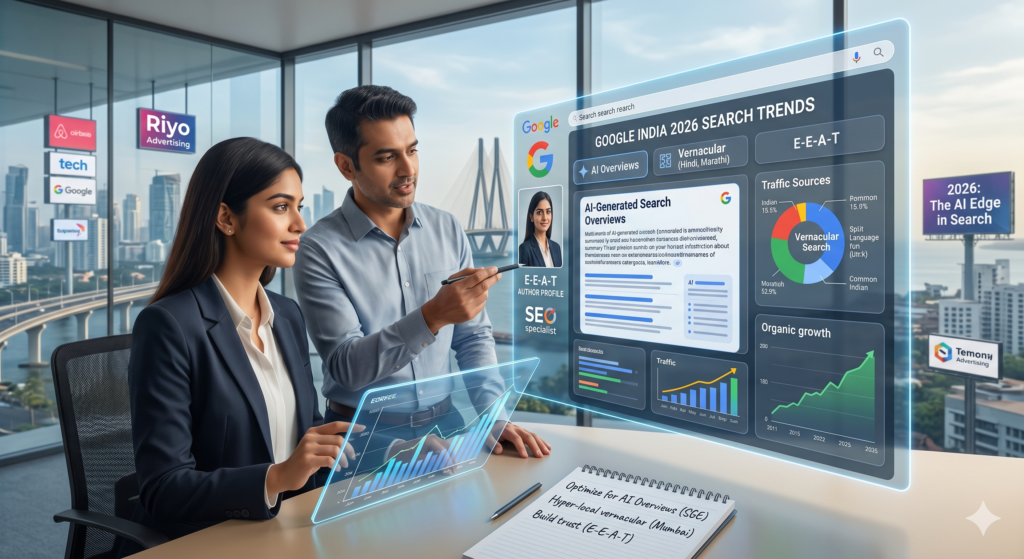
Master SEO in 2026 for the Indian market. Learn to optimize for Google's AI Overviews, hyper-local search, and vernacular content to drive organic growth.
By 2026, Google's AI Overviews (formerly SGE) are the primary way users consume information.
One Mumbai-based financial services company was indexed on 800 pages, blogging over a decade, and its team had been optimising keyword density since 2014. In early 2025 Google made a core update that wiped out 60% of their organic traffic silently. They did not penalise the pages as spam but only as thin, low-trust content that did not meet the actual needs of the users. No penalty notice. No recovery path. Silence of the algorithm.
This situation has become typical throughout India. The companies falling behind are not doing anything evil, they are merely playing the outdated playbook in a search industry that is fundamentally different. It is not about optimisation to an algorithm anymore in Google SEO 2026 India. It consists in pleasing the user to the point where the algorithm cannot but rank you.
In this guide, the three pillars which make someone the winner in Indian search in 2026 are discussed, and what should be done with each of them.
In This Guide
How to Future-Proof Your Strategy: Adapting to the 2026 SEO Structural Break
The change between 2023 and 2026 is not an iterative change: it is an architectural change (Google search evolution). The search engine is essentially attempting to do something different, as Google has incorporated AI-driven search into its primary search product in Search Generative Experience (SGE).
At one point, Google used to rank pages. In 2026, Google provides answers to questions—often via AI Overviews—and then chooses the most authoritative sources to construct answers based on. This difference is critical to the SEO strategy for Indian businesses since it alters the meaning of the concept of organic ranking in an actual sense. A page ranked two in organic search can get virtually no clicks when an artificial intelligence generated snapshot on the top of the query answers the query fully. On the other hand, a brand listed in an AI snapshot at the top of the page might get high-intent traffic despite their organic listing being lower in the list.
There are no tricks to Search Generative Experience tips that actually work in 2026. They are the logical extension of creating authoritative content which is truly AI-readable, technically readable by AI parsing and entity-based SEO, and formatted to respond to specific user search intent instead of just using keywords.
Three contextual factors increase this shift when it comes to Google SEO for Indian businesses in particular. To begin with, the mobile user base of the Indian internet is now larger than ever; more than 75% of Indian searches occur on smartphones, and that indicates Core Web Vitals performance on mobile is a primary ranking factor, rather than a secondary one (mobile-first indexing). Second, the multilingual search behavior of India, where users switch between English, Hindi, Kannada, Tamil and transliterated regional languages within the same session, needs a vernacular content strategy that considers intent across linguistic search features. Third, due to its increasing number of first-time internet users coming through inexpensive 4G and 5G devices, India has different content consumption patterns and voice search requirements compared to the English-first user base that most business websites were initially designed to serve.
Proceed to test your top five priority pages in the PageSpeed Insights tool in Google, not on desktop, but on mobile. When any page has a mobile performance score of less than 75 then that is your priority before any work on content can begin.
Pillar One: Technical Architecture — The Foundation AI Needs to Understand Your Site
Google SEO 2026 India does not start with content as its starting point. It will not cite you, no matter how good your content is; an AI-driven search engine (powering AI Overviews and Search Generative Experience) that cannot read your data, cannot read your site structure, and cannot load your pages fast will not be citing you.
Interaction to Next Paint (INP) Has Replaced FID
The most commonly failed metric by Indian businesses is now INP — Core Web Vitals INP India is one of the most pressing problems due to the differences in the performance of various devices in the country. INP optimization is a metric of your site responsiveness and user experience (UX) signals: how fast your site can reply to a user interaction: clicking a menu, entering a form, tapping a button. A poorly optimised page with heavy JavaScript content, on a mid-range Android device on a 5G connection in Bengaluru, can score INP scores which have a direct suppressive effect on organic rankings and SGE visibility.
Most Indian business websites can be fixed practically by auditing and deferring non-critical JavaScript, decreasing the load of third-party scripts (especially chat widgets and marketing trackers that run on page load), and ensuring server response times are optimised with CDN infrastructure with Indian nodes — Mumbai, Chennai, and Delhi are the key Points of Presence that minimize latency reduction to domestic users.
Schema Markup Has Replaced the Main AI Channel of Communication
Making data structured via JSON-LD structured data in 2026 is not a technical benefit — it is the way in which AI search engines can comprehend what your content entails and not just what it states through semantic search and Entity-based SEO. The product page that has the entire Schema markup (price, availability, aggregate rating, shipping information, and return policy) is readable by the Google Gemini AI in a manner that an unstructured product description simply is not.
The most frequently absent schema types, in the case of Indian businesses, are: LocalBusiness schema with complete address and NAP (Name, Address, Phone) information, which is critical for local SEO, FAQPage schema on service and product pages, Review and AggregateRating schema on business pages with customer feedback, and Organization schema with sameAs properties to your verified social profiles and Knowledge Graph entry where applicable. The gaps in what AI algorithms can comprehend and hence mention about your business are each a missing structured data type.
Audit each page template using the Google Rich Results Test. Correct any errors and then proceed to content optimisation.
Flat Site Architecture for Crawl Efficiency
All of the commercially significant pages on your site must be accessible within three clicks of the homepage to maintain a healthy crawl budget. Deep-buried pages — product categories five levels deep, blog posts not supported by an internal linking strategy, landing pages that only exist as long as paid ads, etc. — are crawled with very low frequency and do not have the PageRank or authority to achieve competitive AI citations.
In the case of Indian companies with large product catalogues or multi-location service pages, this can frequently necessitate a site architecture rethink: flattening navigation, developing robust internal linking between content on high-authority blogs and conversion pages, and making sure that your XML sitemap reflects the pages you actually want to be indexed for mobile-first indexing.
Add your site to Google Search Console (GSC) and monitor the report on indexability and coverage. Any pages in the list of "Excluded" or "Crawled - currently not indexed" are architectural SEO issues or thin content issues — both of which need to be resolved before any other efforts will bear any results in the 2026 search landscape.
Pillar Two: User Intent Strategy — Matching What Indian Users Actually Need
In 2026, user intent is a more defined approach to search engine optimisation strategy. Google's capacity to discern informational, commercial, investigational and transactional intent, and to classify content according to intent, has become so fine-grained that mapping content type to intent category is a sure-fire way to suppress rankings, even for technically well-optimised content.
The Four Intents for the Indian Research Journey
For Indian businesses, the four intent categories have different implications than in western markets, because the Indian consumer's path to purchase often involves more steps in building trust before making a transaction.
- Informational intent ("what is GST input tax credit," "how does SIP work," "best time to buy property in Bangalore") calls for "comprehensive" and expert content. Google's standard for "comprehensiveness" has been raised since 2023. What was good enough 3 years ago (a 600-word overview) is no longer enough (now you need 2,500 words with schema-marked FAQ blocks, byline, and real-life examples). Non-comprehensive information content results in bounces; bounces indicate dissatisfaction; dissatisfied = rankings depressed.
- Commercial investigation intent ("best health insurance for senior citizens India", "top co-working spaces HSR Layout", "compare home loan rates 2026") is the most valuable for Indian businesses because it indicates that a user is in the market to buy. Information for this purpose must be comparative, laying out pros and cons, and designed to assist in decision-making rather than simply pushing a product. Google's ranking systems in 2026 are tuned for comparisons that are thinly veiled promotion.
- Transactional intent ("buy term insurance online", "book interior designer Koramangala", "order custom packaging Bangalore") needs transactional pages rather than informational pages. The Indian business trap here is putting too much copy in the transactional area, and hiding the desired action under copy that should be on an informational page. Concise, simple, fast loading, immediate value proposition, call-to-action.
UX as a Direct Ranking Signal
Bounce rate, session length, and low click-through from search results are now variables in the Google algorithm's consideration of whether your content meets the consumer's needs. For Indian customers - often on 4 inch screens, in various light conditions, with a low tolerance for pop-ups - UX is a variable in the search formula, not a stylistic choice.
The UX "gotchas" that tend to suppress the rankings of Indian businesses: full-page popups that cover up content on mobile, font sizes smaller than 16px when viewed on mobile, menus that don't consistently work in mid-end Android browsers, and designs that put primary content after a long hero banner or above the fold advertorials.
For every top landing page, categorise the intent type it seeks to address - informational, commercial or transactional - and review how well the page structure matches that intent. A product page with too much information, or an informational page with too many sales CTAs, is a misfit.
Pillar Three: E-E-A-T — the Human Signals That AI Cannot Fabricate
Experience Means Being There
The Experience component of E-E-A-T - the initial E, introduced to the original E-A-T model in late 2022 and currently at the heart of the quality evaluation of Google - recognizes content that has proven first-hand engagement with the topic. To an Indian real estate developer it would be original site photography, talking to real residents and documenting construction progress as opposed to stock photography and brochure text. To a Bangalore SaaS company, it would be case studies of named customers, particular metrics, and plain descriptions of implementation difficulties, rather than generic success stories.
Best practice in regard to Indian businesses: include an author signature with credentials to each article. Connect profiles with their LinkedIn profiles, professional certifications or speaker profiles. Google evaluates the authority of authors as a part of page trust - a blog post that has the name Admin as the author has zero E-E-A-T value no matter how well the content is written.
The Only Compounding Link-Building Strategy Is Now Digital PR
The previously effective link-building activities of 2012-2022 directory submissions, paid link networks, guest post farms are not only not effective in 2026, but are also actively harmful. The spam detector by AI driven by Google has been accurate in such a way that links of low quality networks are automatically discounted and patterns of artificial link acquisition have been identified to cause the algorithmic suppression instead of algorithmic gains.
Digital PR link building - getting editorial placements in real publications due to your brand having done something that is worth writing about - is both the most sustainable and the most ROI-positive in 2026. In the case of Indian businesses, this includes finding which publications your target reader consumes: YourStory, Inc42 and Entrackr in the startup ecosystem; The Economic Times and Business Standard in finance and enterprise; and industry-specific niche publications in which your target audience mostly reads.
The process is simple: release original research, proprietary data or a truly valuable industry resource that journalists in your field are interested in citing. A Bangalore HR tech firm that releases an annual compensation survey report of the Indian tech industry will receive regular editorial referrals in publications that report on the industry - links that bear real legitimacy and build up over time.
Find out the three most read publications by your target customers. Consider what original information, research, or knowledge your business would publish that would capture the actual newsworthy attention of those publications. Your digital PR content strategy is that question.
How to Transition From Traditional SEO to the 2026 Model: A Practical Sequence
- First: Thin content audit. Search Google Search Console to find out the pages with high impressions but low clicks and low average positions. They are usually pages that are ranking on keywords but not fulfilling the purpose of the pages. Combine related thin pages into one comprehensive guide, commonly referred to as Power Pages by practitioners, instead of having a variety of underperforming pages with similar terms.
- Second: Have full schema markup. Choose which types of schema are the most applicable to your type of business: LocalBusiness is used in service businesses, Product with Offer and AggregateRating is used in e-commerce, FAQPage is used in any page with a question-answer structure, and Organization is used in your home page and about pages. The Structured Data Markup Helper by Google can be used when you require a step-by-step implementation tool by your development team.
- Third: Restate headings in the form of questions. On each big content page, you should rephrase at least one of your H2 subheads as a question that your target audience is asking. In the first or two sentences of that section, put in a brief and straight forward answer. It is this structure that Google pulls to use as featured snippets and AI snapshot citation - the most prominent spots in 2026 search results.
- Fourth: Construct your CDN infrastructure. To lower latency, deploy a CDN with Indian Points of Presence, as in the case of Indian businesses that have users in more than one city. Cloudflare, AWS CloudFront and Akamai all support Indians. This one technical change will bring Core Web Vitals scores out of the fail range and into the pass range of a significant percentage of your Indian user base.
- Fifth: Have author authority. Design specific author bio pages of all team members publishing content. Add credentials, work experience, professional profiles links, and a photo. Relate these with content using author property of article schema. This creates the author level E-E-A-T signals that Google relies on to determine the content reliability at scale.
Begin thick content audit this week. Go to Google Search Console and filter by pages based on impressions in the past three months and find the bottom quarter in terms of click-through. Those pages are either achieving the wrong goal or are failing to achieve it, either way can be fixed and it will yield faster results than an original piece.
Common Mistakes Indian Businesses Make Transitioning to Modern SEO
Mistake 1: Treating AI Content as a Volume Solution
Spamming content generated by AI without expert editing is the biggest SEO mistake for Indian businesses in 2026. It doesn’t violate plagiarism filters, it uses the right keywords, and it’s comprehensive - but it lacks the first-hand expertise, illustrations, and expertise that Google's quality algorithms are specifically designed to reward.
Fix: AI can write a first draft, create an outline, and conduct research - but insist that a domain-specific expert contribute at least one first-hand specific detail to each article before it's published. This is what makes the difference between getting ranked and being filtered.
Error 2: Neglecting Zero-Click SEO
A common approach among Indian businesses is to monitor rankings and clicks as key SEO metrics, and then see rankings remain consistent but clicks decline - because AI snippets are delivering the answer without a click. This is not a crisis, but a reality of 2026 search that must be planned for.
Fix: For "research" or "knowledge" intent keywords, expect lower clicks, and build brand visibility in AI snapshots, via complete schema, quality content and mentions. Invest in clicks for transactional and commercial pages where the user has to be convinced to do something.
Mistake 3: Link building, not authority
Indian companies that still think link building is about quantity, rather than quality (20 links a month from anywhere), are wasting money on ineffective or even penalising activities.
Fix: Invest link-building funds in content that attracts links: primary research, statistics, tools, real authority guides. A link from an editorial in YourStory or Inc42 is worth more in the long term than 50 directory links.
Mistake 4: Desktop-optimised sites for India's mobile market
Core Web Vitals, user experience quality signals, as well as conversion rates differ between mobile and desktop - and in the Indian market, mobile is the main device. Websites that are optimised for desktop but offer a poor experience on lower-end Android browsers are falling short in India's biggest market segment.
Fix: No performance and UX audit is complete until it's done in mobile simulation. Mobile, not desktop, PageSpeed Insights is the standard.
Mistake 5: No AuthorAttribution on Content
Faceless content has no E-E-A-T value in India. If you do not have identified authors with public credentials publishing your blog, guides and service pages, you are missing the opportunity to communicate a strong signal of content trustworthiness.
Fix: Include author bylines with bio page links. This is a one-off fix with long-term value as author pages build up a track record of content pages and citations from other blogs and websites.
Review five of your top content pages. Do they include author names and author bio pages? If they don't, do this before you create any more content - it is the easiest E-E-A-T fix.
Best Tools for Implementing Modern Google SEO Strategy in 2026
In the era of AI-driven search, your choice of tools must focus on technical precision and E-E-A-T validation. Use these essential resources to optimize your Google SEO 2026 India strategy:
- Google Search Console (GSC): This is your primary diagnostic tool for monitoring how Google’s indexing algorithms view your website. The Indexability (Coverage), Core Web Vitals, and Search Performance reports combined will reveal where your technical, content, and search intent matching issues are within the Search Generative Experience (SGE) landscape.
- Google's Rich Results Test: Use this to validate Schema markup on all page templates. Run it after every structured data or JSON-LD update. The Rich Results Test confirms whether schema errors that may be syntactically valid in code are actually recognized by Google’s AI parser for AI Overviews.
- PageSpeed Insights (Mobile Focus): Prioritize the mobile report for every revenue-generating page. The "Opportunities" section identifies exactly which technical improvements will most significantly impact your Core Web Vitals—specifically Interaction to Next Paint (INP) and Largest Contentful Paint (LCP)—which are critical UX signals for mobile-first indexing.
- Screaming Frog SEO Spider: Execute a comprehensive technical SEO audit to identify thin content (less than 300 words), missing meta descriptions, duplicate H1 tags, broken internal links, and "orphan pages." Resolving these issues is vital for optimizing your crawl budget and improving site architecture.
- Google’s Search Quality Rater Guidelines: These are publicly available at google.com and represent the blueprint for the Helpful Content System. The best way to understand the Google ranking algorithm is to study how human quality raters score E-E-A-T (Experience, Expertise, Authoritativeness, and Trustworthiness). These guidelines are the most detailed source for surviving Google algorithm updates.
Use the free version of Screaming Frog (which crawls up to 500 URLs) to scan your site. Export the list of pages with missing or duplicate meta descriptions and update them directly in your CMS. Well-optimized meta descriptions boost your organic click-through rate (CTR), sending strong positive user engagement signals to Google’s AI, which can lead to higher visibility in AI-generated snapshots.
How Riyo Advertising Helps Indian Businesses Implement Modern SEO
We all know, in theory, what the 2026 SEO stack looks like—but to build it well on a live website, with existing technical, content and business limitations, is another matter. The content and technical SEO capacity to implement the full stack of the three pillars simultaneously is not built into many Indian businesses.
Riyo Advertising offers Indian businesses a portfolio of SEO services Mumbai that cover the entire spectrum of modern search engine optimisation: technical infrastructure audits and fixes including Core Web Vitals and Schema markup, content strategy based on intent mapping (and E-E-A-T) standards, and digital PR strategy for brands in Bangalore, Mumbai, Delhi and other competitive markets in India. Because strategy, tactics, and reporting are in-house, clients work with a one-stop solution for Google SEO 2026 India rather than multiple consultants.
For clients switching from "old" SEO to the 2026 search landscape, Riyo starts with a comprehensive technical SEO audit to identify the specific areas (technical, content and domain authority) that need work before starting new projects. This is important: creating new content on a technically compromised website, or investing in link-building for pages that don't match search intent, will have poor returns even if well executed in the era of Search Generative Experience (SGE).
Indian businesses of all types, from tech companies based in Bangalore to financial services companies in Mumbai and e-commerce brands, that have engaged Riyo in full-stack SEO transitions have reported steady growth in non-branded organic traffic from month five into the future, with visibility in the new generation of AI search citations and AI Overviews improving along with organic ranking metrics.
If you'd like to know how your business measures up to the 2026 SEO approach, contact the team for an expert SEO consultation.
Talk to the Riyo Advertising Team — We'll Help You Get Started
The first step is to know what to change. The second step - getting the technology, content production, and authority signals that Google demands out of today's SEO - while managing a business - is tougher. Riyo Advertising will take care of the second step for Indian businesses that don't want to get into the details of SEO.
When you get in touch, Jyostna or Dinesh will ask you the right questions about your existing site, your competition and your business objectives - and will explain to you what modern SEO would look like for your business - before you are asked to make a decision.
- Call or WhatsApp: +91 98219 84000 / +91 96996 06000 / +91 86571 12011
- Website: https://riyoadvertising.com/
- Ask for: Jyostna or Dinesh
We engage with companies in Bangalore, Mumbai, Delhi and India - and all engagements begin with an open discussion about your needs.
Frequently Asked Questions About Google SEO in 2026
Is keyword density still relevant for Google SEO in 2026?
No. Google SEO 2026 India recognises topical authority (having an in-depth knowledge of a subject that ensures keywords are used within the text), not the repeated use of keywords. High keyword density now leads to quality filters, not rankings. Write for the reader's full understanding of a topic and keywords will be relevant.
Can Indian businesses use AI to write SEO content?
AI tools can help with research, planning and drafting. But, without human intervention, AI content often lacks the personal experience and expertise that Google's E-E-A-T algorithms favour. The rule of thumb: use AI to draft, ask a human expert to review and add value before you publish it. People make the page rank.
What is INP and why does it matter for Indian websites?
Google's Core Web Vitals INP India is a measure of the responsiveness of a page to user interactions, such as clicks on buttons, menu items, or filling out a form. For the mid-end Android phones on which many Indians access the internet, substandard JavaScript results in INP failures that depress mobile rankings. It has replaced First Input Delay (FID) in the Core Web Vitals and is a key technical factor.
How does Search Generative Experience affect click-through rates?
Search Generative Experience and its impact on clicks Search Generative Experience tips for managing this: AI snapshots decrease clicks for queries where the response is contained in the AI snapshot (usually informational). Commercial queries continue to generate lots of clicks because users can't complete transactions in the snapshot. The marketing takeaway is to optimise content for AI citation (being cited as the source of the snapshot) while continuing to optimise for clicks for commercial intent landing pages.
Why is digital PR more effective than traditional link building in 2026?
Digital PR link building generates links from editorially independent, high-authority publications - sources Google's algorithms are designed to heavily cite. Old-school link-building strategies (paid link directories, guest post networks, reciprocal links) result in links that are increasingly being detected and devalued or penalised by Google's AI spam detection systems. The risk-reward ratio for acquiring artificial links has become worse since 2023.
How long does modern SEO take to show results for Indian businesses?
A six-to-12 month timeline for substantial organic traffic increase is reasonable to expect - and this expectation is heavily dependent on the technical debt we have to clear on the current website and the competitive nature of your target keywords. Initial signals (improvements in Core Web Vitals, increase in impressions in Google Search Console, early movement in rankings) will happen in three-to-four months if done right.
Conclusion
Google SEO 2026 India rests on three pillars: technical infrastructure that AI can easily digest and understand, content that aligns with user intent and expertise, and authority signals that can't be faked. Indian businesses that focus on the three have a compounding advantage because they help each other, and because businesses that stick to old-school tactics gradually fall behind.
The move from legacy to 2026-style SEO is not a one-off initiative. It is an operational investment in the quality of your online brand - and one that is sustainable and compounding in the way paid advertising can't be. This week, begin with the thin content audit and the mobile Core Web Vitals audit. Then discuss with the Riyo Advertising team putting together the strategy that's needed for the new Indian search: +91 98219 84000 or riyoadvertising.com